Family organisation for neurodivergent parents: practical ways to make home life easier
What if family organisation for neurodivergent parents started with changing the system, rather than trying harder to fit into it? Appointments, school messages, shopping lists and household jobs can end up scattered across apps, scraps of paper and conversations. Keeping track of them all takes effort, especially when attention, memory or energy shifts from day to day.
If rigid routines feel more stressful than helpful, that doesn’t mean you’re bad at organising. The system may be asking you to remember too much or making important information hard to find. A useful setup should work with your needs, not add another standard to meet.
This guide offers flexible ways to make family life easier to coordinate. You’ll find practical ideas for keeping key details visible, sharing responsibility so one parent isn’t carrying the whole mental load, and building routines that can bend when capacity changes. Start small, use what helps and leave the rest.
Key Takeaways
- Shape family organisation for neurodivergent parents around your attention, memory and energy, rather than aiming for a perfect routine.
- Choose one trusted place for each type of family information, so it’s easier to find and maintain.
- Compare paper lists, reminders and shared calendars by how visible they are and how much upkeep they need.
- Make household handovers clearer by recording who owns a task, its next step and any useful context.
- Use shared tools to support coordination, choosing only the features that suit your family.
Why family organisation can feel different for neurodivergent parents
It’s Tuesday morning. There’s a school message to answer, an appointment to remember and dinner to work out. Before the day gets going, you may already be holding several details in mind while deciding what to do first. Family organisation for neurodivergent parents can feel demanding, not because a parent doesn’t care, but because everyday household admin often relies on remembering, switching focus and getting started at the right moment.
Neurodivergent people don’t all have the same experience. Attention, working memory, task initiation and sensory needs can shape how a system works for each person. These processes are among those often grouped under executive functions. A reminder that helps one parent might become background noise to another. A detailed planner might reassure one person and feel visually overwhelming to someone else. You don’t need a diagnosis to notice what adds friction to your day.
That difference isn’t proof that you’re disorganised, careless or failing. A system can be a poor fit even when you’re putting in plenty of effort. Here, family organisation means making information, tasks and next steps easier to see and share, so fewer details depend on one person keeping them all in mind.
Why ordinary family admin can take more effort
A task often has several invisible steps. You have to remember it, work out where to start, do it in the right order, then return to it if something interrupts you. Arranging a school form, for example, may mean finding the message, locating the form, checking a date and sending a reply. The task can stall at any step, even when it matters to you.
Noise, visual clutter or a last-minute change can add to the effort. A busy kitchen might make it harder to focus on a note, while an unexpected change to the school run can disrupt a carefully planned sequence. These aren’t universal experiences, but they offer useful clues. Notice which parts of household admin take the most effort for you, and when.
What a supportive system should do
A supportive system puts useful information somewhere you can find it, rather than relying on memory alone. It makes the next action clear and keeps the steps manageable on a low-capacity day. That might mean a phone reminder, a short list in a visible place or a shared note that includes the next step.
There’s no need to build an elaborate routine. Try one small change, then adjust it if it adds more work than it removes. Neurodivergent-friendly organisation is a flexible way to make family information and tasks visible, manageable and easier to share, without expecting every parent to organise in the same way.
Build a family organisation system around attention, memory and energy
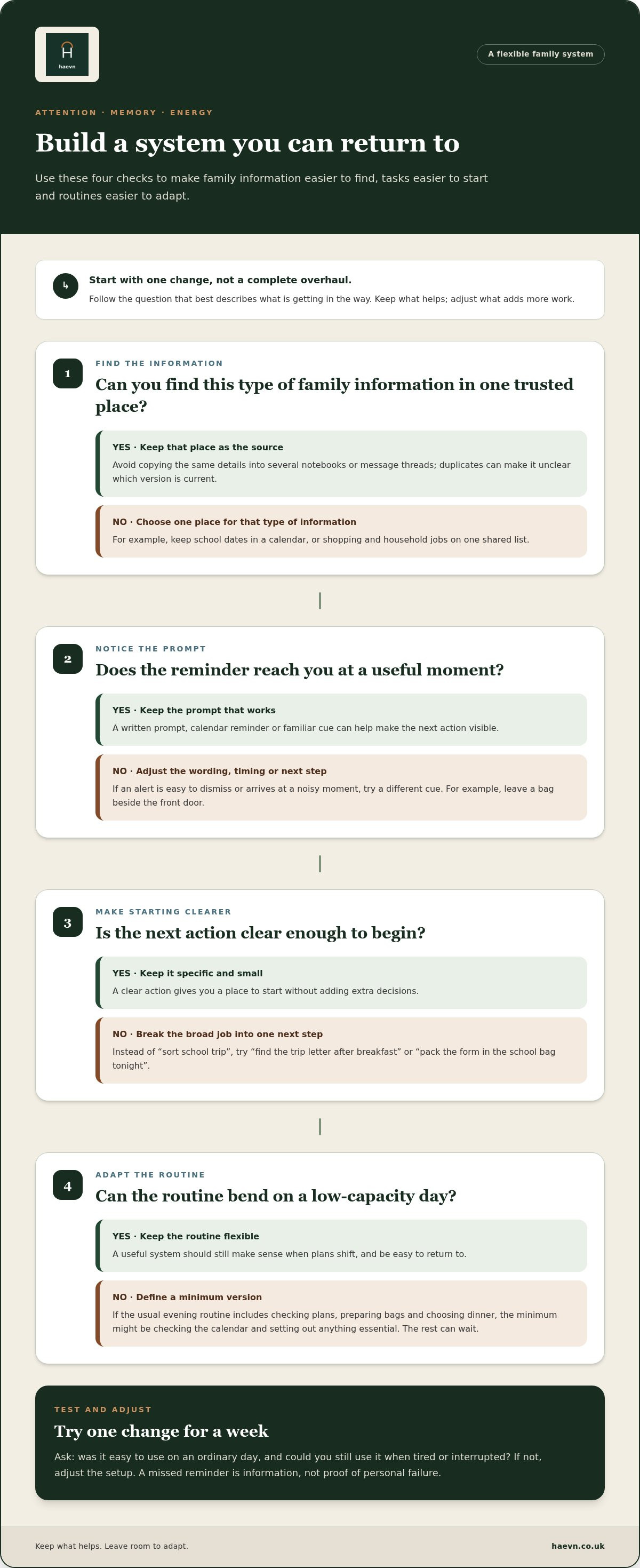
Treat your setup as an experiment, not a routine you have to follow perfectly. Try one change for a week: put school dates in a calendar, for example, or keep shopping and household jobs on one shared list. Then ask a practical question: was it easy to use on an ordinary day, and could you still use it when you were tired or interrupted?
Keep one trusted place for each type of information. If appointments live in a calendar, avoid copying them into several notebooks and message threads too. Duplicates can make it unclear which version is current. A brief weekly check-in can help everyone review what’s coming up and update the right place, without turning organisation into another daily project.
Make reminders visible and tasks easier to start
Broad jobs can be hard to act on because they hide the first step. Replace “sort school trip” with a clear action such as “find the trip letter after breakfast” or “pack the form in the school bag tonight”. Add a time or context that helps you notice the task. A written prompt, calendar reminder or familiar cue, such as leaving the bag beside the front door, may work better than relying on memory alone.
Keep the prompt specific and the next step small. “Deal with the school emails” leaves several decisions to make. “Open the school app and check today’s messages” gives you a starting point. Fewer decisions at the moment of action can make it easier to begin. For further ADHD information and resources, Children and Adults with Attention-Deficit/Hyperactivity Disorder (CHADD) may be a useful place to explore.
Choose a routine that can bend
Build a minimum version for busy or low-energy days. If your usual evening routine includes checking tomorrow’s plans, preparing bags and choosing dinner, the minimum might be checking the calendar and setting out anything essential. The rest can wait. A routine should support family life, not become another measure of whether you’ve done enough.
Missed reminders are information, not proof of personal failure. Perhaps the alert arrived at a noisy moment, was too easy to dismiss or asked you to do too much at once. Adjust its wording, timing or next step. For recurring appointments and commitments, a shared family calendar gives everyone a common place to check what’s ahead.
A useful system isn’t perfect; it’s easy to return to. That’s the test for family organisation for neurodivergent parents: does the setup remain understandable when plans shift, and can you pick it back up without starting again from scratch?
Which family organisation tools help, and when can they become another burden?
The best tool isn’t automatically the one with the most features. For family organisation for neurodivergent parents, it’s the option that makes useful information easy to find without creating more upkeep, decisions or visual noise. A paper note may be more noticeable than a phone alert. A shared calendar may help everyone check arrangements, but only if someone can maintain it.
Use this comparison as a starting point, not a ranking. The same tool can feel helpful or irritating depending on what you need to see and how much effort it takes to keep current.
| Option | Best fit | Possible friction | Keep it manageable |
|---|---|---|---|
| Paper list | Tasks that need to stay in view at home. | It can get buried, damaged or out of date. | Keep one list in a consistent, visible spot and cross off completed tasks. |
| Phone reminders | Time-specific prompts, such as taking something to school. | Alerts can be missed, dismissed or become distracting. | Use clear wording and set reminders only for tasks that need a prompt. |
| Shared calendar | Appointments and commitments the household needs to see. | Details can be duplicated or left out of date. | Agree where events go and review upcoming plans together. |
| Family hub | Household details and tasks that benefit from shared visibility. | Too many sections can create extra choices or upkeep. | Start with one useful area and leave the rest aside unless needed. |
How to tell whether a tool is helping
Try two checks. Can family members find the information they need without asking you to repeat it? Does updating the tool take less effort than sorting out the confusion it replaces? If not, the system may need simplifying, rather than more reminders.
Review it after a change in routine, capacity or household needs. A setup that worked during term time might not suit the holidays. Adjust it when real life changes, rather than trying to make an old arrangement fit every situation.
Keep the system small enough to maintain
Start with one recurring pressure point, such as keeping track of shopping or who needs to do a particular task. Avoid moving every family job at once. Remove duplicate alerts and unused lists if they compete for attention or leave you unsure which one to check.
A shared list feature is one way to make household tasks visible to others. No single app can make every organisational challenge disappear. A tool can support coordination, but it can’t account for every change in capacity, preference or family life. Keep what genuinely helps and let the rest go.
Share family information without making one parent the household reminder system
Shared information can cut down on repeated questions, but sharing doesn’t mean everyone has the same capacity every day. One parent might manage a school update today and need someone else to take the lead tomorrow. The aim isn’t to divide every task equally. It’s to make responsibilities and useful details visible, so one person isn’t expected to remember everything for everyone.
A simple handover can include four details:
- Task: What needs doing?
- Owner: Who has agreed to take it on?
- Next step: What should happen first, and when?
- Context: Is there a date, item or detail that will help?
For example: “Return the school form, Sam, sign it after dinner, it’s in the kitchen drawer.” This is clearer than a general reminder to sort the form, and gives the person taking it on enough context to begin.
Make responsibilities and next steps clear
Agree what “done” means for recurring tasks. For the school run, that might mean the named person is responsible for checking the time and having the necessary items ready. Revisit the arrangement together when work, health or family routines change. Responsibilities can shift without anyone being blamed. For more ideas about coordinating everyday household tasks, see this family organisation guide.
It also helps to agree how reminders should work. Ask which prompts are useful, when they’re welcome and which feel intrusive. A message with a clear next step might help; repeated nudges might add pressure. Preferences can differ, so check in rather than assuming one reminder style suits everyone.
Keep meals and everyday details out of working memory
If dinner choices regularly become a last-minute scramble, try a short shared meal plan or shopping list. Keep it simple: a few meal ideas, missing ingredients and any jobs someone has agreed to handle. Family members can contribute in different ways, from choosing a meal to checking the cupboard or adding an item to the list. They don’t all need to take on the same part.
A family meal planning tool is one option if shared meal ideas would help. Choose only what fits your household, and keep the information easy for everyone involved to find. That’s a practical step towards family organisation for neurodivergent parents that supports coordination without making one person the permanent reminder system.
If a shared place for family tasks would help, set up a shared family space.
How Haevn helps with this
A family hub brings household information into one shared space. For family organisation for neurodivergent parents, shared visibility can make it easier to check what’s happening without relying on one person to keep every detail in mind. It’s a practical coordination tool, not a treatment or a cure, and it won’t remove every task or suit every family’s preferred way of organising.
Use shared tools where they reduce mental juggling
The Hub gives the family a daily overview, while The Plan holds shared calendar details, including recurring commitments. The List supports shared shopping and to-dos, so other family members can check what’s needed or add an item. Family Chat gives household members a place to communicate. These features can make information easier to find, but they don’t complete tasks automatically or remove the need to agree who will do what.
You don’t have to use every feature. Choose the ones that fit your routines and leave the rest aside. The app doesn’t control smart-home devices. Shared information can support coordination, but individual reminders, adjustments and other coping strategies may still be useful.
Start with one small change
Try adding one recurring commitment to The Plan, or start one shared list for shopping or household jobs. Give it time to see whether everyone can find and update the information without adding too much upkeep. If it helps, build from there. If it doesn’t, simplify or try another approach.
The Circle supports up to eight family members under one subscription. A 14-day free trial is available with no card required, giving your household time to see whether a shared space suits the way you organise family life.
Start your free trial. 14 days free, no card required.
Make the next step work for your family
Family organisation for neurodivergent parents doesn’t need to mean keeping a perfect routine or finding one tool that solves everything. Start with a system that suits your attention, memory and energy, then adjust it as family life changes. Keep key details easy to find, make next steps clear and share responsibility without expecting one parent to remember it all.
Small changes count. Try putting one recurring commitment in a shared calendar or making one household list visible to everyone who needs it. Keep what saves effort and simplify anything that becomes another job. A shared space can support coordination, but it isn’t a treatment and won’t remove every task.
If you’d like to try a shared family hub, The Circle supports up to eight family members, and the 14-day free trial requires no card. Take it one step at a time, and choose only what feels useful for your household.
Frequently asked questions
Is there one family organisation system that works for every neurodivergent parent?
No. Needs differ, and the same person may need different support on different days. Start with one recurring pressure point, such as remembering school dates, then test a small change like a visible reminder or shared list. Keep what reduces effort and adjust what doesn’t. The aim of family organisation for neurodivergent parents is a system you can return to, not a perfect routine you must follow every day.
How can a neurodivergent parent remember family appointments?
Put each appointment in one trusted calendar as soon as it’s agreed. Choose reminders that are noticeable but not overwhelming, and add useful details such as who’s going and what to bring. If another adult shares responsibility, make the event visible to them too. A brief calendar check at a time that already fits your family’s week can help everyone see what’s coming up.
Can shared calendars help neurodivergent parents?
They can make dates and commitments easier for family members to see, particularly when recurring events and changes are recorded in one place. A calendar won’t organise every task or suit everyone. Agree what belongs in it, who updates it and which notifications are helpful. Keep other details, such as shopping or household jobs, somewhere easy to find rather than squeezing everything into the calendar.
What should I do when a family routine stops working?
Treat it as useful information, not a personal failure. Consider what has changed: the routine may have too many steps, rely on memory or no longer fit your family’s capacity. Keep the parts that still help and simplify the rest. A minimum version for difficult days can make it easier to restart without rebuilding the whole routine whenever plans or energy levels change.
Can a family organisation app reduce mental load?
A shared app may make information easier to find and help family members coordinate tasks, but it can’t remove the work itself or promise less stress. Choose tools that suit your family’s habits and take little effort to maintain. Start with one feature that addresses a real pressure point, such as a shared calendar or shopping list. Set aside anything that adds more administration than it saves.