Consequences for missed chores: A guide for UK families
Nagging is a symptom of a system that relies on your memory rather than their responsibility. Most parents find themselves stuck in a cycle of shouting and repeated requests, feeling like the only person truly aware of the household's needs. It is exhausting to manage the mental load whilst also acting as the domestic enforcer. Finding effective consequences for not doing chores by age is often the missing link between a cluttered home and a space where everyone contributes. When systems fall apart within a fortnight, it is usually because the connection between action and outcome has become blurred or overly emotional.
You deserve a calmer domestic environment where your children understand the natural impact of their actions. This guide outlines age-appropriate consequences for household responsibilities to help you reduce nagging and foster independence in your children. We will explore how to transition from arbitrary punishments to logical outcomes, ensuring your family routines remain sustainable. By shifting the focus toward shared accountability, you can move away from the role of the constant reminder and towards a more balanced partnership with your family.
Key Takeaways
- Nagging shifts responsibility from child to parent. Break this cycle by building a system based on shared accountability rather than verbal reminders.
- For children aged two to ten, consequences must be immediate to be effective. This guide details specific consequences for not doing chores by age to help younger children learn their role.
- Teenagers respond better to natural outcomes than to authoritarian demands. Foster independence by moving toward consequences that mirror the realities of adult life.
- Consistency is more important than intensity. Use family meetings to collectively agree on responsibilities and the impact of missing them.
- Moving away from verbal enforcement creates a calmer home. Shared responsibility helps children understand how their individual contributions support the whole family.
Why the nagging cycle fails in the modern household
Nagging is a repetitive loop that shifts the burden of responsibility from the child to the parent. When you remind a child five times to clear the table, you've become the keeper of that task; they no longer need to remember it themselves because they know you will. This dynamic is a significant source of mental load, creating a constant hum of domestic friction that leaves everyone feeling drained. It transforms the parent into a supervisor and the child into a reluctant employee, rather than members of the same team.
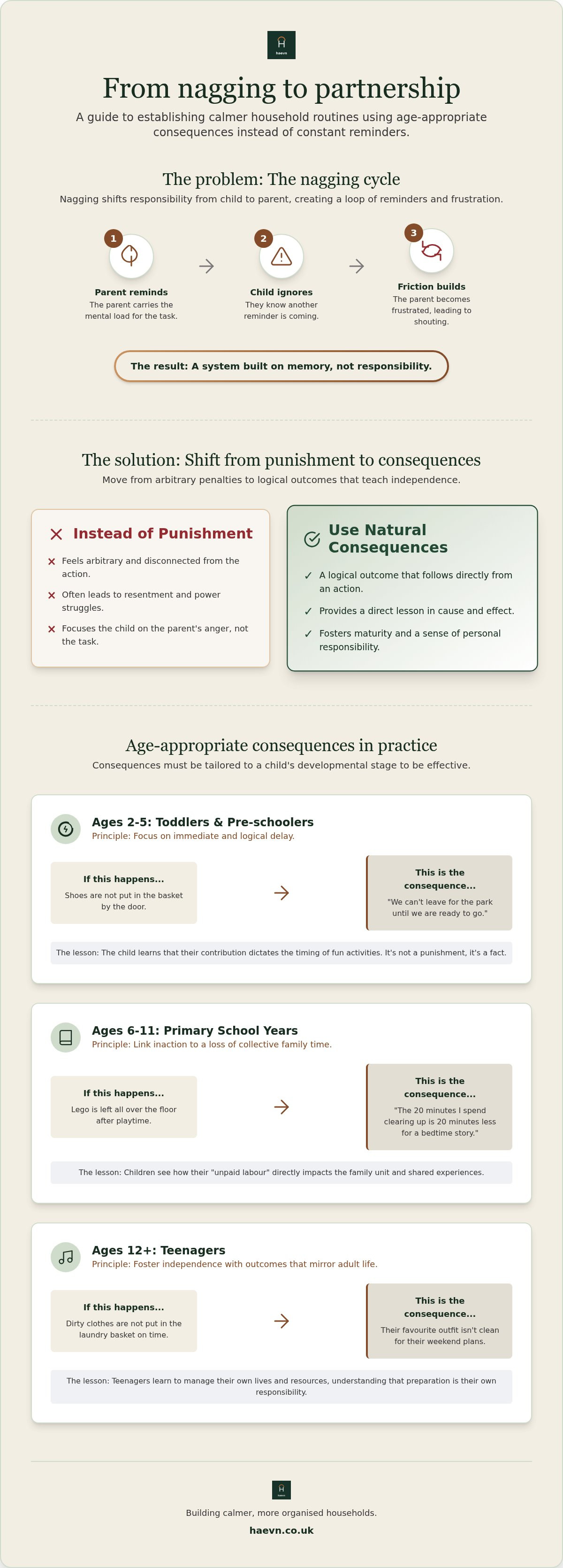
A natural consequence is an outcome that follows logically from an action without parental interference. Understanding the right consequences for not doing chores by age is the first step in moving away from punitive measures, which often feel arbitrary and disconnected from the behaviour. Unlike traditional punishment, natural consequences provide a direct lesson in cause and effect. Taking away a screen because the bin wasn't emptied feels like a power struggle; dealing with a smelly kitchen is a direct result of the missed task. This shift fosters maturity by allowing the child to experience the actual impact of their choices.
The psychology of household responsibility
Children frequently perceive chores as "extra" work or a favour they're doing for their parents. They don't naturally see the house as a collective project that requires maintenance. Developing a sense of ownership is vital for a child's competence; when they own a task, they understand its value. Moving from a "doing for" model to a "doing with" approach changes the energy of the home. Historically, families have used chore charts to make these expectations visible, helping children see their contributions as essential rather than optional.
Moving from punishment to partnership
Traditional punishments often lead to resentment and defiance rather than genuine behaviour change. When a child feels attacked, they focus on the unfairness of the penalty rather than the missed responsibility. Viewing the home as a shared ecosystem helps reframe the conversation. In this environment, everyone's actions, or lack thereof, affect the whole family. Establishing clear consequences for not doing chores by age means that outcomes are predictable and agreed upon in advance. When the rules of the ecosystem are transparent, the need for emotional outbursts disappears, replaced by a calm understanding of shared duty.
Age-appropriate consequences for younger children
Children between the ages of two and ten undergo immense developmental shifts. Their ability to grasp abstract concepts like "responsibility" is limited; their environment must provide clear, tangible feedback instead. For younger children, consequences for not doing chores by age must be immediate to be effective. Their brains are wired to prioritise the present moment. A penalty applied tomorrow for a missed task today will feel like an unrelated act of frustration rather than a lesson.
The "now-that" approach is a powerful tool for this age group. It frames the chore as a prerequisite for the next activity rather than an arbitrary hurdle. By saying, "now that the toys are away, we have space to play a game," you are highlighting a physical reality. This shift helps the child see that their actions directly create the conditions for their own enjoyment. It moves the focus from parental control to personal agency.
Toddlers and pre-schoolers (ages 2-5)
At this stage, the focus should be on logical delay. If shoes are not in the basket, the family cannot leave for the park. It is not a punishment; it is a simple fact of life that we need shoes to go outside. Using visual cues, such as a photo of a tidy shelf or a simple drawing, helps them understand the expected outcome. For a toddler, the consequence for not doing chores by age is rarely more complex than a delay in the fun. They learn that the speed of their contribution dictates the timing of their reward.
Primary school years (ages 6-11)
As children enter primary school, they can begin to understand the impact of "unpaid labour" on the family unit. If a parent has to spend twenty minutes clearing up Lego that was left out, that is twenty minutes less time available for a bedtime story. This is a natural consequence that links their inaction to a loss of collective family time. It is a direct, non-emotional trade-off.
Consistency in these early years is essential to help avoid power struggles during adolescence. You might choose to link specific privileges, such as screen time, directly to the completion of tasks. If the coat remains on the floor, the tablet stays in the drawer. To help manage these expectations, you can learn how to make a chore chart that works for your family. Keeping these boundaries firm allows children to feel secure in the rules of the house. If you are ready to move away from verbal reminders, you can create your own shared space to manage these routines.
Navigating chores and independence with teenagers
Teenagers are in a unique developmental stage where they crave independence whilst still requiring guidance. For this group, the focus must shift from parent-led discipline to life-led consequences. Authoritarian demands often trigger defiance; autonomy, however, encourages cooperation. The natural outcome of a teenager failing to do their laundry is simple: they have no clean clothes for their weekend plans. This approach treats the home as a rehearsal for adult life and living with flatmates. It is a space where no one will nag them, but the impact of their inaction will be felt immediately. As children grow, the parental role evolves from a supervisor to a consultant, guiding them through these real-world stakes.
The secondary school transition (ages 12-15)
During the early secondary school years, the "service fee" model can be an effective way to handle missed responsibilities. If a parent has to step in to complete a teen's task, it costs a portion of their time or pocket money. This reframes the conversation around the value of labour and the cost of someone else's time. For example, if a teen ignores the dishwasher, a small, agreed deduction from their allowance covers the "service" of you doing it for them. When met with the "I will do it later" excuse, avoid the argument. Simply agree on a clear deadline and stick to the consequence if it is missed. It is vital to show that consequences for not doing chores by age are linked to freedom; demonstrating responsibility builds the trust needed for later curfews or more social independence.
Preparing for the real world (ages 16-18)
By the time a young person reaches sixteen, they should be viewed as a co-habitant rather than a child being managed. If the bins are not put out, the house smells for everyone, including them. Their actions have a collective impact. Ditching chores might also affect family transport or social plans. If the car cannot be used because a parent is still finishing the teen's "shared" housework, the teen misses their lift. This age group needs to see that rewards for younger children no longer apply. You can read more about why sticker charts fail and what works instead. Focusing on the social contract of the household prepares them for the realities of university. It is about understanding that in any shared space, everyone must pull their weight to maintain harmony.
Establishing a consistent system to reduce the mental load
A system is only as good as its consistency; its intensity matters far less. Many households start with elaborate programmes that fall apart within a week because they are too demanding to maintain. A simple, predictable routine is always more effective than a complex one. Holding a regular family meeting is a practical way to establish this. In these sessions, you can collectively agree on responsibilities and the resulting consequences for not doing chores by age. When everyone has a voice in the rules, they are more likely to respect them. The goal is to create a single, central point of truth for the household. This allows the system to do the nagging so that you do not have to.
Agreeing on the consequences for not doing chores by age during a family meeting removes the element of surprise. It means that everyone understands the rules before they are broken. This collective agreement shifts the dynamic from parent-versus-child to the family-versus-the-task. It creates a shared understanding that the house belongs to everyone.
The power of visual accountability
Verbal reminders are often perceived as nagging, whilst visual lists are seen as facts. When you tell a child to tidy their room, it can feel like a personal demand. When the requirement is written on a shared list, it is simply a task that needs doing. Categorising chores by frequency helps maintain this clarity. Daily routines, like clearing the table, should be separated from weekly deep cleans, such as vacuuming the stairs. Seeing their progress in a physical or digital space allows a child to take ownership of their role. It moves the conversation from an emotional plea to an objective observation of what still needs to be ticked off.
Keeping the system calm and quiet
Effective communication relies on the rule of "six words if six will do." When a task is missed, a short, neutral statement is better than a long lecture. Pointing to the agreed list is often enough to prompt action without raising anyone's blood pressure. To keep the system fair, review it every fortnight. This allows you to adjust tasks as children grow or as family schedules change. You can find more detail on this approach in our guide on how to stop nagging kids to do chores: A new system. By keeping the process objective and calm, you reduce the emotional weight of household management. If you are ready to centralise your family's routines, you can start building your household system today.
How Haevn helps with this
Haevn acts as a centralised hub that brings every part of a UK household into one calm space. It is designed to reduce the psychological burden of domestic management by moving the mental load from your memory to a shared platform. By using Lists, you can assign household tasks and track routines without the need for constant verbal reminders. This visibility means that everyone knows their role, making the enforcement of consequences for not doing chores by age a matter of objective record rather than emotional conflict. Home gives a daily overview of family activities, ensuring that progress is visible to all members at a glance.
It is important to clarify that our platform is not a game app. We do not use animated avatars, digital coins, or virtual bribes to encourage children to participate. Our philosophy is rooted in shared accountability within People, which supports up to 8 family members. We focus on building real-world habits and a sense of partnership, rather than relying on the frantic energy often found in productivity tools or children's trackers.
Shared accountability through Lists
Seeing a task on a shared digital list removes the friction of "he said, she said" debates. When a chore is documented, it becomes an undisputed part of the day's schedule. This clarity is essential when managing consequences for not doing chores by age, as it provides a neutral reference point for everyone in the home. For younger children, routine lists are particularly effective for building the foundational habits discussed earlier in this guide. This visual accountability helps children understand that their contributions are a necessary part of the household ecosystem. Our privacy-first design means that your family's private sphere remains protected, creating a secure environment for your personal information.
A single subscription for the whole household
We provide straightforward pricing that fits the budget of a modern family. Our service costs £6.99 a month or £69.99 a year for your entire household. There are no per-user fees, tiers, or hidden upsells; one subscription covers everyone. This flat rate allows your whole family to stay connected and organised without worrying about rising costs. Haevn is built to UK GDPR standards.
Building a home of shared responsibility
Transitioning from the role of a domestic enforcer to a coordinator requires a fundamental shift in mindset. By understanding the right consequences for not doing chores by age, you move away from arbitrary punishments and towards logical, real-world outcomes. This approach reduces the mental load on you whilst teaching your children the actual value of their contributions. A calm home isn't built on shouting; it's built on clear boundaries and the steady rhythm of a consistent system. When everyone knows exactly what is expected, the need for constant reminders disappears.
Haevn brings the household into a single, calm space for the whole family. Our privacy-first design is built to UK GDPR standards, keeping your personal data secure. For a flat rate of £6.99 per month, up to 8 family members can sync their routines and share the load. It is a straightforward way to bring order to modern domestic life without the friction of constant nagging.
Start your free trial. 14 days free, no card needed.
You have the tools to create a more balanced household. Take the first step today and watch your family's independence flourish.
Frequently Asked Questions
At what age should kids start doing chores?
Children can begin participating in household tasks as early as age two. At this stage, chores should be simple: putting a teddy in a basket or helping to match clean socks. The focus is on the habit of contribution rather than the quality of the work. Establishing these routines early makes implementing consequences for not doing chores by age much easier as they enter primary school and beyond.
How do you handle a child who flatly refuses to do a chore?
Respond to flat refusal by calmly applying the pre-agreed consequence rather than engaging in a power struggle. If a child refuses to tidy their toys, the next activity is delayed until the floor is clear. You don't need to shout; the "now-that" rule does the work for you. Consistency is your most powerful tool. If the consequence is predictable, the child eventually learns that refusal only delays their own fun.
Should chores always be linked to pocket money?
Linking chores to pocket money is a personal choice, but many UK families find it effective for teaching the value of labour. There is no single right amount, so agree one that suits your household. However, basic hygiene tasks should often remain a standard expectation of living in a shared home. This helps avoid children from viewing every contribution as a financial transaction.
What are the best natural consequences for a teenager?
The most effective consequences for a teenager are those that mirror adult life. If they don't put their laundry in the basket, they will eventually run out of clean clothes to wear for social events. If they don't wash their favourite mug, it won't be available when they want a drink. These "life-led" outcomes teach self-sufficiency and reduce the need for parental nagging, preparing them for future independence.
How do I stop being the only person who notices the mess?
You must move the mental load from your head to a shared central point of truth. When chores are only noticed by you, they feel like your personal burden. Using a shared digital list or a physical chart makes the mess an objective fact that everyone can see. This shifts the responsibility from you "noticing" to the system "reminding." It allows the whole family to participate in the oversight of the home.
Can a digital system work for children who are not tech-keen?
A digital system works well for non-tech-keen children if it prioritises clarity over complex features. The system should act as a simple, functional tool rather than a game or a distraction. When a child can see a straightforward list of their responsibilities, they can take ownership without needing advanced digital skills. The focus remains on the task itself, making the coordination of consequences for not doing chores by age much more manageable.