Best app for UK blended families: Household co-ordination
Blended and stepfamilies are a familiar part of UK family life, and the traditional nuclear model is no longer the only standard. Finding a dedicated app for blended families UK parents can rely on has become a logistical necessity rather than a digital luxury. You likely feel the weight of managing two school holiday calendars, coordinating handovers, and splitting the cost of new school uniforms across two separate households. It's a relentless mental load that often leads to friction rather than flow.
We understand that you want a home that runs on harmony, not just hectic text messages. This article demonstrates how a centralised digital hub can simplify these complex logistics and restore a sense of order. You will discover how to harmonise schedules, divide household expenses fairly, and reduce the administrative burden on every parent and step-parent. We will explore the essential tools that turn a cluttered family life into a streamlined, peaceful partnership where everyone stays informed and valued.
Key Takeaways
- Consider whether you need a tool built for legal evidence, or a household hub that prioritises daily coordination and positive co-parenting.
- Utilise a "virtual fridge door" to give every family member clear visibility over complex holiday rotas, handovers, and school schedules.
- Discover how a dedicated app for blended families UK parents trust can reduce the mental load by centralising chore lists and shared expenses in one place.
- Involve children in digital organisation to foster independence whilst ensuring they feel secure in their routine across two separate homes.
- Replace fragmented messaging with a calm, all-in-one space that protects your private family data under strict UK privacy standards.
The complexity of managing a blended family in the UK
A modern UK household often extends beyond a single front door. When we consider what is a blended family, we see a complex web of relationships and responsibilities that require more than just a basic calendar to manage. Many parents and step-parents are navigating the logistical hurdles of two homes, varying work schedules, and shared custody arrangements. Standard calendar apps can struggle to bridge this gap because they aren't built for the nuance of co-parenting. They lack the necessary privacy controls and the ability to host a single source of truth that respects the boundaries of all members involved.
Finding a dedicated app for blended families UK households can rely on is about more than just dates. It's about creating a safe, organised space where everyone feels informed without the constant ping of intrusive messages. This digital coordination means that the focus remains on the children's well-being rather than the friction of administrative oversight.
Understanding the mental load in two households
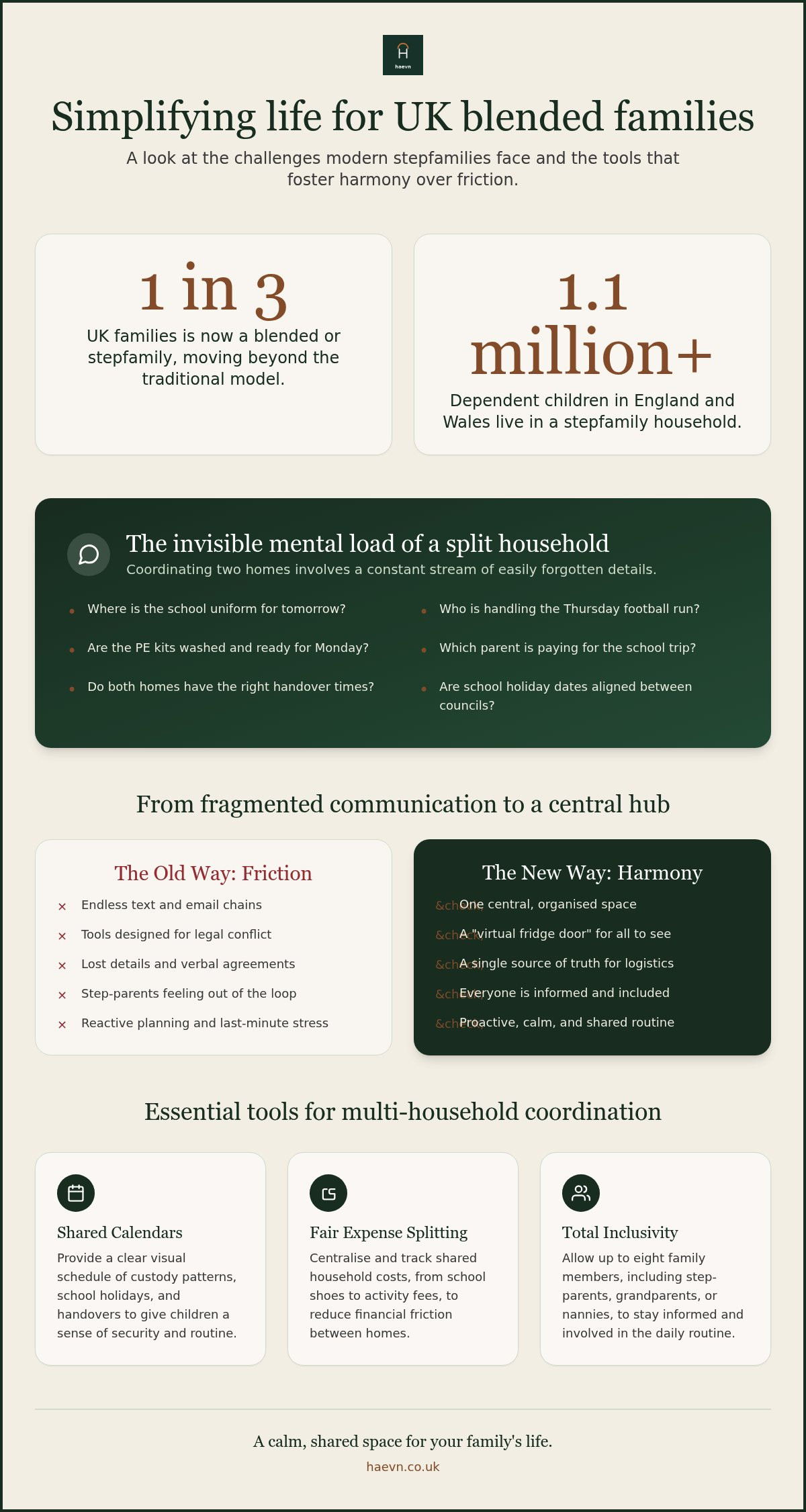
The mental load in a blended family is often invisible but incredibly heavy. It involves tracking which house the school uniform is at, ensuring PE kits are washed and ready for Monday morning, and remembering which parent is responsible for the Thursday football run. These details are easily lost in fragmented WhatsApp threads or verbal agreements. In the UK, school holiday dates can vary significantly between local councils and regions, making holiday planning a potential minefield without shared visibility. By using a centralised hub, parents can see the entire landscape of the family's commitments at a glance. This shared oversight reduces the psychological burden on any one individual, allowing for a more balanced partnership between households.
The role of step-parents in digital coordination
Step-parents often play a vital role in daily logistics, yet they can frequently feel excluded from primary coordination tools. An inclusive digital hub changes this dynamic by allowing up to eight family members to stay in the loop. This means that step-parents have direct access to the schedule, shopping lists, and household chores without needing to constantly ask for updates. Carer Mode gives a nanny or grandparent limited access, with visit notes. When everyone has the same information, the household moves with a collective rhythm. Order is no longer a goal; it's a daily reality that fosters a sense of security and trust for every family member.
Essential features for multi-household coordination
Managing a multi-household lifestyle requires tools that go beyond the capabilities of a standard office calendar. For a British blended family, the priority is often synchronising two different sets of rules, routines, and physical locations. An effective app for blended families UK residents use must act as a neutral ground where logistical information is accessible to everyone without the emotional weight of a direct confrontation. This digital space becomes the foundation for a well-ordered home, providing clarity where there was once confusion.
Shared calendars and Plan
A visual schedule is a vital tool for a child's sense of security. When children can see exactly which days they spend at each home, it reduces anxiety and helps them prepare for transitions. Plan and Co-Parenting allow you to integrate complex, repeating custody patterns alongside specific UK school holiday dates. These dates often differ between primary and secondary schools or across different local authorities, making a unified view essential.
To make the most of this visibility, consider these practical steps:
- Colour-code events: Assign a specific colour to each family member so the day's commitments are scannable at a glance.
- Include travel times: Add handover durations to the calendar to ensure everyone has a realistic expectation of the day.
- Mark school-specific dates: Log INSET days or "World Book Day" early to avoid last-minute panics over costumes or childcare.
This centralised view means no one is left guessing about the week ahead. It moves the family away from reactive planning and towards a proactive, calm routine.
Budgeting for two homes and Pot
Financial coordination is a frequent source of friction in blended households. Whether it's splitting the cost of new school shoes or contributing to a school trip, tracking these irregular expenses is vital. The ONS publishes Census 2021 figures on children in families, including stepfamilies, and many families still struggle with the "who owes what" conversation. Manual expense tracking often proves more practical than automated banking links because it allows for nuance and privacy.
Many parents find that linking personal bank accounts to a shared tool feels like an unnecessary invasion of privacy. Instead, using a manual entry system for shared costs allows you to log expenses as they occur. This transparency means that both households have a clear record of contributions, reducing the need for awkward discussions about money. It's about maintaining a fair division of costs whilst keeping your private financial data secure. If you are ready to bring this sense of calm to your daily routine, you can explore our coordination tools today.
Beyond the numbers, coordination involves the small details of daily life. Shared lists for groceries or household chores ensure that nothing is forgotten during a busy week. Keeping family business within a dedicated app for blended families UK also keeps sensitive discussions away from social media platforms. This provides a safer, more private environment for your domestic data.
Comparing conflict-focused tools with household hubs
When choosing an app for blended families UK parents may come across tools designed mainly for high-conflict separations. These applications focus on uneditable logs and "tone checkers" to manage high-conflict separations. While these features are necessary in specific legal scenarios, they can inadvertently keep a family in a state of perpetual dispute. A household hub, by contrast, focuses on the future. It prioritises the rhythms of daily life, fostering a sense of shared partnership rather than a legal standoff. The shift from "documenting evidence" to "coordinating a home" can change the tone. It allows parents to step out of a courtroom mindset and into a supportive, domestic atmosphere where order is easily attainable.
British families often prefer a calm, ad-free environment for their most sensitive data. A dedicated household hub provides a safe haven away from the frantic energy of social media or the rigid structure of legal tools. This shift in focus helps to reduce the psychological burden on co-parents, step-parents, and children alike. It transforms the digital experience from a chore into a breath of fresh air.
Privacy first in the digital age
Data security is paramount when children's schedules and physical locations are involved. Some "free" organiser apps are funded by advertising, so check how an app uses your family's data. A subscription means the app does not need advertising to pay for it. Tools built to UK GDPR standards provide a protective layer for your personal information, ensuring that your family's private sphere remains private.
The ICO Children's Code, also known as the Age Appropriate Design Code, is a set of 15 standards that online services must follow to protect children's data privacy in the UK. By adhering to these standards, a professional app for blended families UK residents trust acts as a guardian of your domestic data. This privacy-first approach fosters a feeling of security, allowing you to manage your household with total peace of mind.
The value of a unified household subscription
Financial transparency starts with the tools you choose to use. Some co-parenting apps charge each parent separately, which can quickly become a significant expense for a multi-household unit. A unified household subscription offers a more equitable and organised approach. A single flat rate for the entire family, often covering up to eight members, means that everyone is included without additional costs. This model is fairer because it doesn't penalise families for their size or the number of households involved. It also gives the whole household one consistent place for coordination.
Creating a shared routine for children and parents
Establishing a sense of belonging in two different homes requires more than just a shared custody schedule. Children often feel as though they are living out of a suitcase, constantly transitioning between different sets of household rules. A central digital hub acts as the "virtual fridge door" for the modern family. It provides a stable point of origin for information that stays consistent regardless of which physical house the children are in. Choosing a comprehensive app for blended families UK parents can access on the go means this continuity, creating a digital home base that travels with the family.
Beyond the logistics, Family Chat gives the household one private place to talk, away from public social media.
Building independence with Lists and Chores
Children thrive when they understand what is expected of them. By using Chores and Lists, you can involve children in the daily rhythm of the home, fostering a sense of responsibility and independence. Automated reminders reduce the need for constant verbal prompts from parents, which often helps to lower the temperature in step-parent relationships. When the app sends the reminder, the child responds to the routine rather than a perceived "nag."
Consider these age-appropriate tasks to help children feel settled in their routine:
- Primary school: Checking the list to ensure their PE kit is packed for the correct house.
- Secondary school: Managing their own laundry schedule or logging school project deadlines.
- Transition days: Using the shared view to see who is collecting them from the school gate.
This transparency empowers children to take ownership of their own schedules. It turns a complex transition into a predictable, manageable part of their week.
Meal planning and reducing decision fatigue
Decision fatigue is a common burden for British parents, especially when coordinating across two kitchens. A weekly meal planner helps to manage the diverse tastes and dietary needs of a blended household. If you are dealing with fussy eaters or specific allergens, having a centralised record of favourite recipes and dietary filters helps avoid last-minute stress. It means that everyone feels considered at the dinner table.
You can also use a "Use It Up" feature to track what's in the pantry, which helps to reduce food waste and save money on the weekly shop. In an era of rising costs, these small efficiencies make a significant difference to the household budget. If you want to replace the "what's for dinner" panic with a calm, organised plan, you can start your trial, 14 days free, no card needed and experience the relief of a synchronised kitchen. By centralising these daily choices, you create more space for meaningful family time.
How Haevn helps with this
Haevn is designed as a singular, calm sanctuary for the modern British household. It replaces a fragmented collection of notes, texts, and spreadsheets with a unified digital environment. As a dedicated app for blended families UK parents can trust, it prioritises synchronisation over surveillance. Home provides a clear, scannable overview of the whole family's day, ensuring that no one is left out of the loop. It brings together Plan, Pot and House into a single point of origin for all family activities.
We believe in transparency regarding our capabilities. Haevn does not offer automated bank syncing. This is a deliberate choice to protect your financial privacy and ensure that you remain in total control of the data you share across households. Manual entry for shared expenses allows you to track costs for school trips or club fees without exposing your entire transaction history. It's about providing oversight whilst respecting individual boundaries. This approach fosters a feeling of security and trust, positioning the platform as a safe haven for your domestic data.
The Haevn Monthly and Annual Plans
Our pricing is designed to be simple, inclusive, and fair. Haevn costs £6.99 a month or £69.99 a year. A single subscription covers up to eight family members, making it an affordable way to include co-parents, step-parents, and older children without the need for individual user plans. Magic Inbox, which will turn family admin emails into tasks, is coming soon. This all-in-one value proposition means that your household management remains organised and cost-effective, regardless of how many homes are involved.
Safety and support for UK families
Your family’s security is our primary concern. Haevn is built to strict UK GDPR standards, ensuring your data is never sold or misused. If you need help, you can email support@haevn.co.uk. By integrating all aspects of family life into one experience, we help you reclaim the value of your time.
It is vital to acknowledge that digital tools are not a substitute for professional safety. If you are experiencing domestic abuse, please contact the National Domestic Abuse Helpline on 0808 2000 247 or visit your local police station for support. We are committed to fostering healthy, supportive family environments for every user, providing a breath of fresh air in a cluttered digital landscape.
Restoring harmony to your multi-household life
Managing a blended family shouldn't feel like a constant legal exercise. By shifting your focus from conflict documentation to daily coordination, you create a more supportive environment for everyone involved. You've discovered how shared visibility over calendars and expenses reduces the mental load whilst fostering independence for children moving between two homes. Choosing a dedicated app for blended families UK households can rely on means that every parent and step-parent remains informed, valued, and connected.
Haevn provides this calm, organised space without the intrusion of ads or the risk of data selling. Our platform is built to strict UK GDPR standards, keeping your private family life secure and protected. With one plan covering up to eight members for £6.99 a month or £69.99 a year, it's an equitable solution for the whole household. Start your trial. 14 days free, no card needed. Take the first step toward a more harmonious, well-ordered home where the focus is back on the moments that truly matter. You have the tools to turn logistical chaos into a steady, peaceful rhythm.
Frequently Asked Questions
Is Haevn suitable for co-parents who live in separate homes?
Yes. Co-Parenting adds a shared calendar for two homes, so co-parents can coordinate schedules, share school information, and manage costs without needing constant direct contact. By providing a single source of truth for both homes, it reduces the friction often associated with handovers and changing routines. This means that every parent stays informed and involved.
How many family members can I add to my Haevn plan?
You can add up to eight family members to a single Haevn plan. This inclusive approach means that co-parents, step-parents, and older children can all stay informed within the same digital space. It is a practical app for blended families UK residents can use to keep extended support networks, such as grandparents or nannies, updated on the family's weekly rhythm without incurring extra costs.
Haevn is a coordination hub focused on daily household harmony rather than a tool for gathering legal evidence. Co-Parenting keeps a sealed message record that either parent can export with verification codes, but whether any record is admissible is a decision for the court and your solicitor. Our goal is to help families move forward with a positive, future-focused routine.
Can I use the app to track my children's location?
Location sharing is optional and off by default, and in Co-Parenting your co-parent can never see your location through Haevn. The app focuses on providing clear visibility through shared calendars and plans. This means everyone knows where they should be based on the agreed schedule, fostering a sense of trust and security throughout both households.
Is there a free version of the Haevn app available?
No. There is no free tier. You get 14 days free, no card needed, with access to Plan, Pot and House. After that it is £6.99 a month or £69.99 a year for the entire family.