Teaching kids about budgeting with a family hub app
As more payments go contactless, the concept of money has become almost entirely invisible to the next generation. When every purchase is a silent tap of a card, it's difficult for a child to grasp that a digital balance isn't an infinite resource. If you're searching for a teaching kids about budgeting app, you're likely looking for a way to make these abstract numbers feel real without the constant friction of nagging about chores or pocket money.
It's natural to feel some hesitation, especially as many teenagers report feeling anxious about money. You want to provide security whilst building their confidence. This guide offers a calm approach to introducing financial literacy by using your existing household management tools. We'll look at how to build a habit of transparency, reduce the stress of managing rewards, and show your children how a household budget actually functions in a safe, private environment.
Key Takeaways
- Understand why the shift away from physical cash makes money feel infinite to children and how to reintroduce tangible limits.
- Identify the differences between simple spending tools and a comprehensive teaching kids about budgeting app that involves the whole family.
- Learn how to distinguish between fixed household costs and discretionary spending to build a foundation for financial literacy.
- Discover a practical method for linking chores to rewards without the need for constant reminders or friction.
- Evaluate the importance of data privacy when selecting digital tools to ensure your family's financial information remains secure.
The challenge of teaching financial literacy in a cashless society
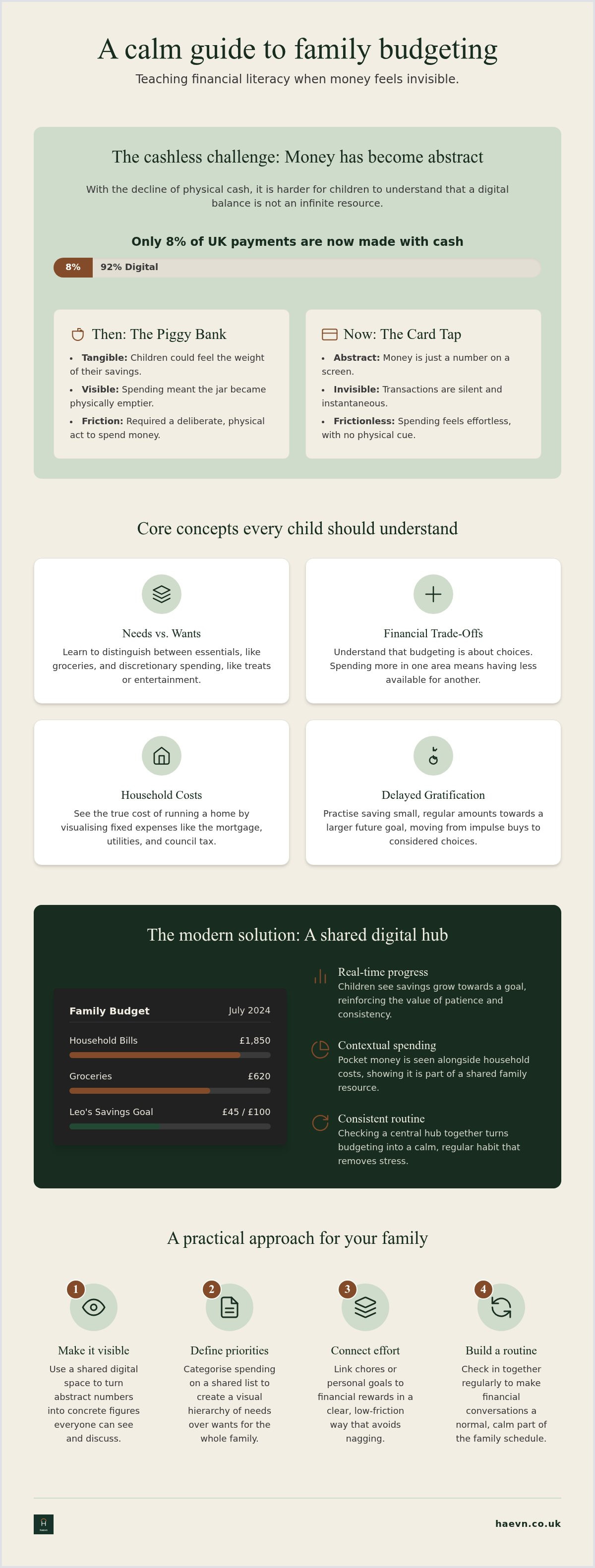
The shift from physical coins to digital transactions has fundamentally changed how children perceive value. In previous generations, a piggy bank offered a tactile lesson. You could hear the clink of a coin and feel the weight of the jar increasing as you saved. When money was spent, the jar became physically lighter and the loss was visible. Today, that physical connection has largely vanished.
Developing financial literacy in a world of contactless payments requires a deliberate change in strategy. Most children now see spending as a magic tap of a card or a phone. Without a physical representation of what remains, it's difficult for them to understand that a digital balance represents a finite resource. This is why many parents look for a teaching kids about budgeting app to bridge the gap between invisible numbers and real-world consequences. Modern British families need a central point to organise these conversations so they don't get lost in the daily rush.
Why digital money feels invisible to children
Digital spending lacks the friction that once helped us manage our impulses. When a child watches a parent pay for groceries with a smartphone, there is no exchange of notes or counting of change. The transaction is instantaneous and silent. This lack of physical feedback can lead to a distorted view of wealth where resources seem infinite as long as the card is present.
To counter this, families must work to make the invisible visible. Visualising a balance in a shared space helps ground these abstract concepts. It moves the conversation away from a mysterious refusal at the checkout towards a transparent discussion about what the family has decided to prioritise. When a child can see the numbers moving in a shared dashboard, the "magic" of the card tap is replaced by an understanding of cause and effect.
The shift from piggy banks to digital dashboards
The modern equivalent to the kitchen table ledger is the digital dashboard. Whilst the piggy bank was a solitary tool, a shared hub allows for a more collaborative approach to household finances. It acts as a central point for all financial discussions, ensuring that everyone is looking at the same information at the same time.
Using a dashboard provides several benefits for a child's development:
- Real-time progress: Children can see their savings grow towards a specific goal, which reinforces the habit of delayed gratification.
- Contextual spending: Seeing their pocket money alongside wider household categories helps them understand that money is a shared tool.
- Consistent routine: Checking a central hub once a week builds a habit of financial awareness that persists into adulthood.
Consistency in checking the hub builds a routine that removes the anxiety often associated with money. Instead of a stressful monthly confrontation, budgeting becomes a calm, regular part of the family schedule.
Core budgeting concepts every child should understand
Budgeting is often misunderstood as a practice of restriction. In reality, it's the process of aligning a family's spending with its values and actual needs. When you use a teaching kids about budgeting app, the goal isn't just to track pennies, but to demonstrate that every financial choice involves a deliberate trade-off. If the household spends more on energy this month, there is less available for the cinema. This is a fundamental lesson in adult life that many children miss when money remains an abstract concept managed by parents in private.
Understanding these trade-offs helps develop delayed gratification. By choosing to save smaller amounts now, children learn they can achieve more significant long-term goals later. This shift in perspective moves them away from impulsive spending and towards a more considered approach to their resources. Every financial decision becomes a choice between an immediate want and a future security.
Distinguishing between needs and wants in the household
The first step in financial education is identifying the difference between fixed costs and discretionary spending. You can use a shared dashboard to show how essential bills and groceries are always prioritised over treats. Within House, you can list the recurring costs that keep the home running, such as the mortgage or utilities. Seeing these figures helps children understand the true cost of living and the responsibility involved in maintaining a household.
You can further this by categorising items on Lists. Labelling an item as an "essential" or an "extra" creates a visual hierarchy of needs. It transforms a simple shopping list into a lesson on priority. When children see that the milk and bread must come before the premium chocolate, they begin to internalise the logic of a household budget. It's a simple way to show how resources are allocated according to what is necessary for the family to function.
The role of the family pot in shared expenses
Collective responsibility is a powerful teaching tool. Introducing a shared fund, such as Pot, allows the whole family to work towards a common goal like a summer holiday or a new garden bench. When children see the balance grow through shared effort, they feel a sense of ownership over the family's success. It moves the dynamic from "can I have this" to "how are we doing with our goal".
Transparency is key to this process. By allowing children to see the progress in a shared space, you remove the mystery of how large purchases are funded. They can contribute through their own chores or by choosing to put a portion of their pocket money aside. This collaborative approach fosters a sense of partnership rather than a top-down hierarchy. If you are ready to bring your family into the conversation, you can create your shared space today and start building these habits together.
Choosing the right tool for family financial education
Many digital tools currently on the market focus purely on the point of sale. Whilst a dedicated debit card for a child can be useful for small purchases, it rarely teaches the broader discipline of household management. If you are looking for a teaching kids about budgeting app, you should prioritise a tool that views money as part of a wider ecosystem. Budgeting doesn't happen in a vacuum; it's connected to your schedule, your shopping lists, and your long-term family plans.
Choosing a subscription-based model over a free version is often a wise investment in your family's digital security. Free apps often rely on advertising or the sale of behavioural data to remain viable. By paying a flat rate, you ensure that the environment remains ad-free and that the developer's only priority is providing a functional service for your household. This transparency is vital when you are introducing children to the digital world for the first time.
Why data privacy matters for children's financial habits
Financial data is deeply personal. For children, this information is even more sensitive and must be protected to UK GDPR standards. You should avoid platforms that encourage excessive monitoring or use "gamified" features to nudge children into specific spending patterns. A secure family hub provides a sanctuary where children can learn through trial and error without being influenced by external marketing or having their habits analysed by third parties. Learning about money should be a private family matter, not a data point for a corporation.
The limitations of standalone pocket money apps
Managing a separate app for chores, another for a calendar, and a third for pocket money significantly increases the parental mental load. Isolated tools also fail to reflect how money flows through a real household. In a standalone app, money often appears as a magical digital balance that refills once a week without any visible connection to the rest of life.
When financial education is integrated into a central hub alongside meal plans and shared lists, it gains context. Children can see that the money in Pot is linked to the activities on Home. This integration provides a more realistic perspective on how adults manage their time and resources. It moves away from the idea of money as a separate "game" and positions it as a practical tool for living a well-ordered life.
Practical steps to start budgeting as a family
Financial education is most effective when it moves away from theory and into the rhythm of daily life. You don't need a formal curriculum to teach these skills. Instead, integrating discussions about money into your existing household management is a more natural approach. If you're using a teaching kids about budgeting app, the goal is to make these conversations a regular, low-stress part of your week. A simple ten-minute review of the family hub each Sunday afternoon can set a calm tone for the days ahead.
This weekly check-in is a chance to look at the upcoming schedule and the resources required. It's not about restriction, but about clarity. When everyone is looking at the same information, there is less room for misunderstanding or last-minute requests that strain the budget. It allows children to see how their individual plans fit into the wider family picture.
Introducing chores and rewards without the friction
Nagging about unemptied bins or unmade beds is exhausting for parents and children alike. By using Chores, responsibilities become objective rather than a source of personal conflict. Children can see exactly what is expected of them, and automated reminders help them take ownership of their tasks without a parent needing to intervene. This builds a sense of autonomy that is vital for long-term financial independence.
Linking these completed tasks directly to pocket money rewards provides immediate feedback. In early 2026, the average weekly pocket money for UK children was £9.90 according to GoHenry data. Whatever the amount you decide on, seeing their balance update as a direct result of their effort reinforces the link between work and reward. It moves the conversation away from a parental handout towards an earned resource that the child has the agency to manage.
Meal Planner is another practical tool for this education. By involving children in selecting meals, you can discuss the cost of ingredients and the importance of reducing waste. When children see that a planned menu stops the need for expensive last-minute takeaways, they understand the practical value of a budget. If you're ready to simplify your household management, you can set up your family hub and begin these conversations today.
Setting collective goals for the household
Individual saving is a useful skill, but collective goals teach children about shared priorities and partnership. Choose a goal that the whole family can support, such as a trip to a theme park or a new garden trampoline. Visualising the progress in a shared area like Pot keeps motivation high. When everyone can see how close the family is to the target, it encourages a sense of shared success.
Transparency in this process removes the mystery of how larger purchases are funded. It shows that big goals are reached through steady, consistent effort over time. Celebrate together once the goal is reached. This celebration reinforces the positive habit of saving and proves that collective effort leads to tangible results that benefit everyone in the household.
How Haevn helps with this
Haevn acts as the central point for your household, bringing together your schedule, tasks, and finances in one place. By positioning budgeting within a wider management tool, it becomes a natural part of daily life rather than a separate, isolated task. As a teaching kids about budgeting app, it provides the structure needed to make digital numbers feel tangible without the complexity of traditional financial software. Order is attainable when everyone is looking at the same dashboard.
The system is designed for the whole family, allowing up to eight members to participate. You can assign tasks through Chores and link them to rewards, providing a clear path from effort to financial gain. Because everything is centralised, children can see how their contributions help the household run smoothly. This shared partnership reduces the psychological burden of management and fosters a sense of collective effort.
Using Pot for transparency and education
Pot offers a calm environment to view household finances together. Unlike apps that focus on individual spending, this feature allows you to categorise expenses to show children exactly where the family's resources are allocated. You can create categories for groceries, energy, or weekend activities, helping children understand the difference between fixed costs and discretionary spending.
Manual entry is a core part of this process. By recording expenses yourselves, you maintain total control over your data and ensure that the act of budgeting remains a conscious, deliberate choice.
What Haevn does not do
Honesty is paramount in how we describe our service. Haevn is not a banking app and does not hold or move your money. It does not offer automated bank feeds, which is a deliberate choice to ensure your privacy remains intact and your data is built to UK GDPR standards. We do not provide debit cards for children, as we believe the foundation of financial literacy is best built through shared household transparency first.
It is also important to clarify that Haevn is not a tracking tool or a parenting app designed for monitoring children's movements. We do not sell behavioural insights or use your family's data for external marketing. Our goal is to provide a safe haven for your personal information, offering a professional space where you can coordinate your life with foresight and reliability. The service costs one flat rate of £6.99 per month or £69.99 per year for the entire household.
Building a foundation for financial confidence
Teaching children to manage money in a cashless society doesn't have to be a source of friction. By moving away from isolated spending tools and towards a shared household dashboard, you make the invisible visible. You've seen how linking chores to rewards and discussing meal costs can ground abstract numbers in reality. Using a dedicated teaching kids about budgeting app within a wider family hub means that financial literacy becomes a natural, daily habit rather than a formal lesson.
Haevn provides a secure space for this education, built to UK GDPR standards to keep your family's data private. For one flat rate of £6.99 per month, you can include up to eight family members in your shared hub. This collaborative approach reduces the mental load of management whilst fostering a sense of collective responsibility across the household.
Start your free trial. 14 days free, no card needed
Building these habits now provides your children with the clarity they need for a more secure future.
Frequently asked questions
What is the best age to start teaching kids about budgeting?
Most experts suggest starting financial education around the age of seven, which aligns with when children begin learning basic maths at school. At this stage, they can understand the concept of exchanging value for goods. You don't need a complex teaching kids about budgeting app for younger children; simple discussions about the price of toys are enough. As they grow, you can introduce more structured tools to manage their increasing independence.
Are free budgeting apps safe for my children's data?
Free apps often present a privacy risk because they frequently rely on advertising or selling behavioural data to remain viable. When children's financial habits are tracked, it can lead to targeted marketing that influences their spending. It is safer to choose a service built to UK GDPR standards that operates on a subscription model. This means the platform's only priority is your family's security rather than monetising your private household information.
How can I explain the cost of living to a child?
Explaining the cost of living is easier when you use concrete examples from your own household. Show your children the recurring costs in House, such as energy bills or the mortgage, and compare them to discretionary spending like cinema tickets. This helps them understand that a large portion of the family income is already committed to essentials. It moves the conversation away from abstract numbers towards a practical understanding of how a home is maintained.
Should I link chores directly to pocket money?
Linking chores directly to pocket money is a personal choice, but it can be an effective way to teach the connection between effort and reward. Using a shared feature like Lists allows you to set clear expectations and provide immediate feedback when a task is finished. This approach helps children take ownership of their responsibilities. It also removes the friction of nagging, as the reward is tied to their own initiative rather than a parental reminder.
How many family members can use Haevn under one plan?
One Haevn plan includes up to eight family members, allowing everyone in the household to participate in the budgeting process. This inclusive approach means that parents, children, and even grandparents can stay synchronised on shared goals. The service costs one flat rate of £6.99 per month, which covers the entire group. There are no individual user fees or tiers, making it a straightforward way to manage a busy household's logistics and finances in one central space.
Does Haevn link to my British bank account?
Haevn does not link directly to any British bank accounts or provide automated bank feeds. This is a deliberate design choice to ensure your financial data remains entirely private and secure. By using manual entry in Pot, you maintain total control over what information is shared within your family hub. This method also encourages more mindful spending habits, as the act of recording an expense requires a conscious moment of reflection that automated systems lack.