Shared notes for family members: Keeping everyone informed
You are standing in the hallway, bags packed for the school run, trying to find the date for the upcoming inset day. You scroll through three different chat threads, past photos of the dog and dinner requests, only to find the information was in an email you deleted last week. Most of us manage our households through a chaotic mix of memory and messaging apps, yet using shared notes for family members offers a far more stable solution. It's exhausting to be the person who always knows where the spare key is or when the car insurance expires. This mental load often falls on one partner, turning simple domestic admin into a source of constant friction.
Moving essential details out of your head and into a collective space creates a single, reliable point of truth for the whole household. This guide explains how to organise your family information, from grocery lists to emergency contacts. You will learn how to set up a system that keeps everyone informed, ensuring that the responsibility for running a busy British home is shared rather than carried alone.
Key Takeaways
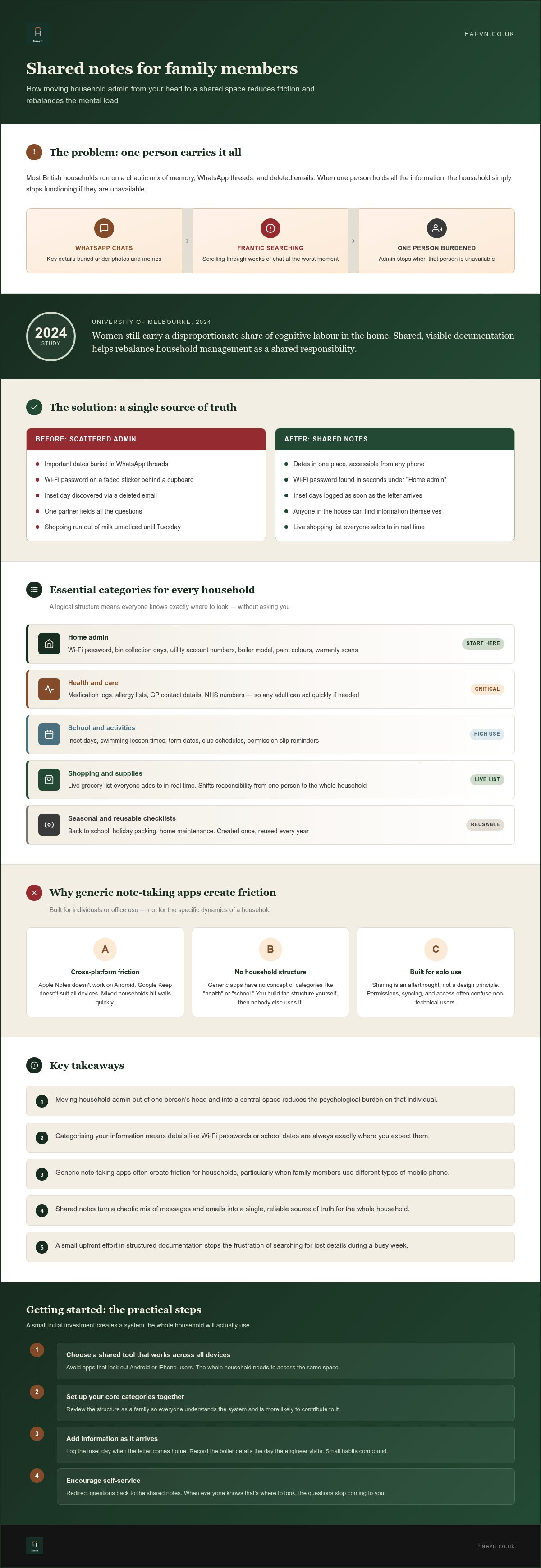
- Moving household admin out of your head and into a central space reduces the psychological burden on a single person.
- Categorising your information means that details like Wi-Fi passwords or school dates are always exactly where you expect to find them.
- Generic note-taking apps often create friction for households, especially when family members use different types of mobile phones.
- Adopting shared notes for family members turns a chaotic mix of messages and emails into a single, reliable source of truth.
- A small initial investment in structured documentation stops the frustration of searching for lost details during a busy week.
Why shared notes are essential for the modern British household
The mental load is a heavy, invisible weight. It is the constant effort of remembering that the boiler needs servicing in October, that the school inset day is next Tuesday, or that the Wi-Fi password is on a faded sticker behind a heavy cupboard. When one person holds all this information, it creates an information silo. If that person is busy or unavailable, the household admin simply stops. Using shared notes for family members acts as a central point of truth for everyone. It moves essential details out of one person's memory and into a collective digital space. While paper lists are easily lost or left on the kitchen counter, digital notes stay with you, providing access from any location.
Reducing the mental load through shared access
Knowing exactly where information is kept reduces daily anxiety. You no longer need to field constant questions about where the spare lightbulbs are or what time the swimming lesson starts. Shared documentation allows for self-service information, where partners and older children can check the details themselves. This shift is significant for domestic balance. Shared notes help rebalance this by making household management a visible, shared responsibility rather than a private burden carried by one person.
Transitioning from scattered chats to a single source
Most families rely on WhatsApp threads for coordination. These chats are helpful for quick updates, but they are poor for long-term storage. Important details like holiday dates or gift ideas quickly get buried under photos, memes, and casual conversation. Searching for a specific message whilst standing in a GP surgery or a busy supermarket is frustrating and time-consuming. A dedicated note system provides a calm alternative. Instead of scrolling through weeks of chat history, you go straight to the relevant category. It turns a frantic digital search into a simple, reliable reference point that everyone can trust.
Categorising your family information for better clarity
Effective notes aren't just about writing things down; they're about being able to find them when life is busy. If your digital space is cluttered, nobody in the house will use it. A logical structure for shared notes for family members means that every piece of information has a designated place. This isn't just for your benefit. When everyone knows the system, they don't have to ask you where to find the bin collection schedule or the pet insurance policy. Reviewing these categories as a family helps everyone understand the logic behind the system, making it far more likely that they will contribute to the upkeep of the household.
Essential categories for every household
Start with the basics of domestic admin. This category should include the Wi-Fi password, bin collection days, and utility account numbers. These are the details everyone needs but nobody wants to memorise. Health and care notes are equally vital. Keep medication logs, allergy lists, and GP contact details in a shared space so that any adult in the house can act quickly if needed. Different types of information require different levels of detail. Some notes might be simple lists, whilst others, like home maintenance records, might need to include photos of serial numbers or scans of warranties. Recording the specific paint colours used in the lounge or the boiler model saves hours of searching through old receipts or guessing at a DIY shop whilst standing in the aisles.
Routine and shopping lists
Shopping lists work best when they're live. A weekly list that everyone can contribute to in real time stops the "we've run out of milk" surprise on a Tuesday morning. It shifts the responsibility from one person checking the cupboards to everyone noting down what they've finished. Beyond groceries, routines can help manage the daily flow of the house. Morning or evening routines for children encourage independence, as they can check the list themselves rather than waiting for verbal instructions. Seasonal checklists are also useful. Create a "back to school" or "holiday packing" note that can be tucked away and reused every year. If you're ready to move away from scattered scraps of paper, you can get started with a structured household hub today.
The limitations of generic note-taking apps for families
Most of us begin by using the default note apps that come pre-installed on our phones. They are convenient and usually free. However; these tools are built for individuals or office environments, not for the specific dynamics of a household. When you try to use generic shared notes for family members, you quickly run into technical walls. If one partner uses an iPhone and the other uses an Android device, sharing a native note often becomes a mess of broken links or read-only access. This friction discourages people from using the system. Before long, the household reverts to scattered messages and verbal reminders.
The problem with free tier privacy
Free apps often rely on data harvesting to stay profitable. Your family's life is private. Details about your children's school routines, your home security codes, or your health history shouldn't be used to build an advertising profile. Choosing a platform built to UK GDPR standards is a deliberate step toward protecting your household's digital boundaries. A paid, ad-free environment isn't just about avoiding annoying banners; it's about ensuring your personal data remains personal. It provides a sense of security that free alternatives simply cannot provide.
Fragmentation and the friction of use
The biggest hurdle is often fragmentation. You might have a great shopping list in one app, but your family calendar is in another, and your household budget is in a third. This constant switching between interfaces increases the mental load. You find yourself copying information from an email into a note, then checking the calendar to see if the date matches. It's a digital obstacle course. A unified hub is different. It brings these elements together, so you don't have to jump between tools just to find out who is picking up the dry cleaning on Friday. When information is scattered, it stays lost. When it's centralised, it becomes useful.
Reducing the mental load through structured documentation
Managing a home is often a series of reactive responses to immediate problems. You search for the vet's number only when the cat is ill, or scramble for passport details an hour before booking a holiday. Structured documentation is a proactive way to manage a home. It requires a small initial time investment to save hours of future searching. By using shared notes for family members to record the repetitive or essential details of your life, you ensure that the household continues to run smoothly even when the primary organiser is unavailable. This collective approach turns household admin into a shared asset rather than a private burden.
Five steps to setting up your family notes
Building a reliable system for shared notes for family members is straightforward if you follow a logical path. First; choose a central platform that every family member can access regardless of their device. This removes technical barriers and means everyone is looking at the same information. Second; audit your current hidden information. Think about the passwords, routines, and contacts that only you know. Third; create clear categories using the framework discussed in previous sections to keep things organised. Fourth; invite family members and explain the system. Buy-in is essential, so explain how this will make their lives easier too. Finally; set a recurring time, perhaps once a month, to prune and update the information. If you are ready to centralise your household admin, create your family hub to begin organising your documentation.
Involving children and carers
Documentation is a tool for the entire household, including children and external support. Using shared notes for chores or daily routines can build independence in older children. Instead of relying on verbal instructions, they can check the list themselves, which reduces friction and builds confidence. For households that rely on nannies or grandparents, providing specific access is invaluable. A dedicated mode for carers allows them to see essential details like allergy lists, school pick-up routines, or emergency contact numbers without needing full access to your private family admin. Clear, simple instructions ensure that anyone stepping in to help can do so with confidence, whilst keeping your most sensitive information secure.
How Haevn helps with this
The platform provides a calm, unified space for all family documentation and admin. It replaces the frantic search through multiple apps with a single, composed atmosphere. Instead of managing shared notes for family members in isolation, the hub integrates your documentation into the wider context of your daily life. This approach means that information is not just stored, but actually used to reduce the mental load on everyone.
Lists is where the daily flow of the house lives. It handles the weekly shopping, children's morning routines, and recurring chores. When someone finishes the milk, they add it to Lists, and everyone sees the update. For the more static details of home life, House serves as a dedicated manager. It is the place for boiler models, warranty dates, and utility account numbers. When you need to know which fuse belongs to the kitchen, the answer is exactly where you expect it to be.
You can invite up to eight family members or helpers under one subscription by email.
A privacy-first approach for UK families
Privacy is at the core of the experience. The platform is built to UK GDPR standards, which means your family data is never sold or used for advertising. The subscription model is straightforward; one plan at £6.99 per month or £69.99 per year covers the entire household. This means an ad-free experience that prioritises the security of your information over scale. You can learn more about the Haevn Monthly Plan to see if it fits your household's needs.
What Haevn does not do
We are transparent about what the tool is not. Haevn is not a workplace productivity tool or a generic project manager. It is designed specifically for the domestic sphere. We do not offer a free forever tier; we believe that family privacy is too important to compromise for a free version funded by data. Additionally, it does not allow for individual, private accounts within the family group. It is built for the collective household, focusing on shared transparency rather than individual silos. Understanding how Haevn supports busy families helps in deciding if this unified approach is right for your home.
Building a more balanced household
Shifting from a reactive approach to a proactive documentation system changes the atmosphere of a home. When you use shared notes for family members, you aren't just making lists; you're creating a sense of shared partnership. This visibility means that household admin is no longer the private burden of one person but a collective resource everyone can access. By moving essential details into a central, privacy-first hub, you reclaim time and reduce the daily friction of lost passwords, school dates, or forgotten routines.
A single subscription covers up to eight people for £6.99 per month, providing a secure, ad-free environment that replaces the need for separate calendar, budget, and note apps. It's a calm, organised way to keep everyone informed without the noise of scattered chat threads or fragmented messages. Start your free trial. 14 days free, no card needed.
Taking this small step today creates a more predictable and supportive environment for your whole family. It allows you to move away from the chaos of modern domestic life and towards a home where everything has its place.
Frequently asked questions
How do I share a note with my family members?
You share a note by inviting others to a common digital space, usually via a link or email. In a household hub, you send an email invitation to bring everyone into the same environment. This means that everyone has the same level of access to the information. Once they accept, they can view and edit the content in real time.
What is the best app for shared family notes in the UK?
The best app is one that bridges the gap between different mobile devices and prioritises privacy. For UK households, look for a platform built to UK GDPR standards that offers a unified space for notes, calendars, and budgets. This helps avoid the need to switch between multiple tools, which often causes information to get lost or ignored by less tech-keen family members.
Is it safe to store sensitive information like passwords in a shared note?
Storing sensitive details like Wi-Fi passwords or alarm codes is safe if you use a secure, privacy-first platform. Avoid free apps that may sell your data to advertisers. A paid service means your family's personal information remains private. Using shared notes for family members in a dedicated hub provides a much safer alternative to sending passwords over insecure chat threads or leaving them on paper.
Can I use shared notes for co-parenting after a separation?
Shared notes are highly effective for co-parenting as they provide a neutral, objective record of information. They help manage school dates, health details, and clothing sizes without the need for constant, potentially stressful communication. Using a shared digital space allows both parents to stay informed about the children's needs while maintaining clear boundaries and reducing the overall mental load.
How many family members can contribute to a shared note system?
The number of contributors depends on the specific tool you choose. Some individual note apps limit sharing to a few people, but a dedicated family hub typically supports up to eight members under one subscription. This is usually enough to include partners, older children, and even external carers like grandparents or nannies, ensuring that everyone responsible for the household stays informed.
Do shared notes work across both iPhone and Android devices?
Yes, shared notes work across different platforms if you use a tool designed for that purpose. Generic apps built by phone manufacturers often have limited functionality when shared between iPhone and Android users. A dedicated household platform removes these barriers, allowing every family member to contribute regardless of which phone they use. This cross-platform compatibility is essential for a system to be truly useful.