Reduce food waste at home: A guide for busy UK families
Binning good food is frustrating, especially when you consider the rising cost of the weekly shop and the quiet guilt of seeing perfectly good produce go to waste. If you're wondering how to reduce food waste at home, the solution usually begins with addressing the irritation of finding a third bag of spinach at the back of the fridge or throwing out bread forgotten during the mid-week rush.
It's a common struggle, but managing your kitchen doesn't have to feel like a second job. This guide explains how to coordinate your kitchen and involve the whole family in a simple, sustainable system. We'll look at better planning methods, smarter storage habits, and how to create a shared approach that stops duplicate buying and lowers your monthly food bill.
Key Takeaways
- Understand the financial impact of food waste on your household budget.
- Learn how to reduce food waste at home by involving the whole family in a structured weekly meal plan.
- Distinguish between use-by and best-before dates to keep food for longer and organise your fridge for better visibility.
- Create simple routines for using up surplus ingredients, such as a weekly dinner to clear the vegetable drawer.
- Coordinate shopping lists across the household to avoid buying duplicate items and lower your monthly bills.
Understanding the cost of food waste in British households
The financial reality of Food waste in the United Kingdom is stark. This is not just about the odd bruised apple or a forgotten crust of bread. Households account for a large share of the national total. When we look at the logistics, learning how to reduce food waste at home is the most direct way to lower your monthly outgoings without sacrificing the quality of your meals.
The impact of this waste extends far beyond your bank balance. Every item of food that ends up in the bin also represents the wasted water, energy, and transport used to get it to your table. Household food waste adds up to a large amount nationally, along with the emissions that come with it. Addressing this at the source, in our own kitchens, is the most effective way to make a difference to both your budget and the environment.
The hidden price of the weekly shop
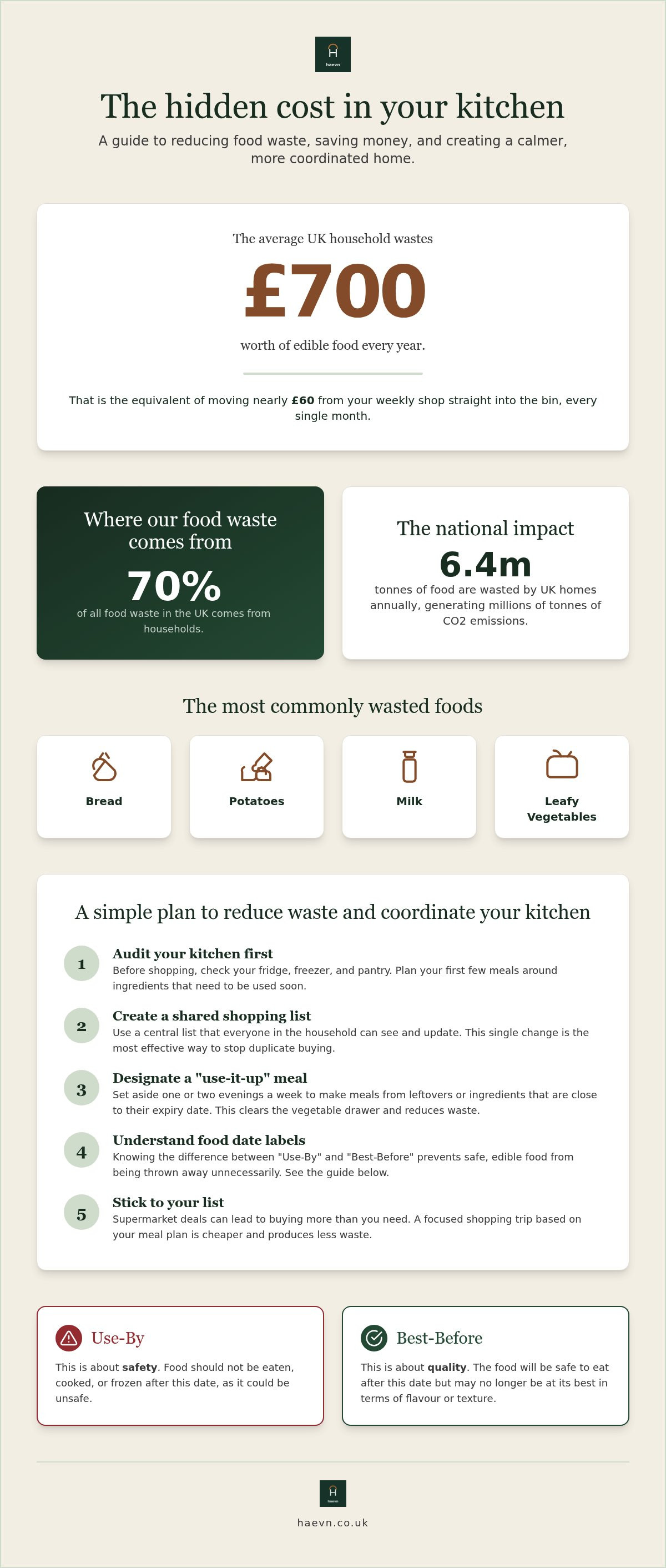
Think of wasted food as a pile of groceries moved straight from the car to the bin. With food price inflation remaining a constant pressure on the family budget, efficiency in the kitchen has moved from an environmental choice to a financial necessity. Bread, potatoes, milk, and leafy vegetables are the most common items to be discarded. A tidy, visible pantry does more than just look better. It provides a psychological sense of order that makes meal times feel less chaotic. When you can see exactly what you have, you are less likely to buy duplicates or let fresh produce wither away in the bottom drawer.
Why our kitchens become cluttered
Clutter often starts before we even reach the front door. Supermarket deals frequently result in a surplus that our fridges simply cannot accommodate. This lack of visibility means that fresh ingredients are pushed to the back, forgotten until they are no longer safe to eat. The mental load of managing a busy household often leads us to choose the convenience of a new purchase over checking what we already have. We buy what we think we need, rather than what we actually require. This disconnect is a primary reason why how to reduce food waste at home remains a challenge for busy families. It is a failure of coordination, not a lack of care. Recognising this helps us move away from guilt and towards better systems for the whole family to follow.
Mastering the art of the weekly meal plan
A successful meal plan is the foundation of a waste-free kitchen. Many families fail because they treat planning as an individual task rather than a collective effort. When one person plans a meal whilst another buys ingredients for something else, waste is inevitable. Understanding UK food waste statistics helps put this into perspective; much of our waste comes from simple miscommunication. Learning how to reduce food waste at home effectively requires a system that everyone in the house can see and follow.
Five steps to an effective family meal plan
A reliable plan doesn't need to be complex. Start by auditing your fridge, freezer, and pantry to find lurking ingredients that need using. Once you know what you have, select recipes based on those items first. This helps avoid you from buying a new bag of rice when you already have two half-opened ones at the back of the cupboard. Create a shared shopping list that every family member can access. This reduces the frustration of duplicate purchases. Designate one or two use-it-up nights each week for leftovers or expiring items. Finally, stick to your list whilst at the supermarket. Impulse buys are often the first things to go off before they can be eaten.
Coordinating with fussy eaters
Plate waste is a significant issue for families with children. Reducing this requires a balance between offering variety and ensuring the food is actually eaten. Try serving smaller portions of new foods alongside reliable favourites to see what works without throwing away whole meals. You can also adapt recipes for different dietary needs by keeping base ingredients separate, such as serving pasta with sauce on the side. If you are struggling with specific preferences, our guide on meal planning for fussy eaters offers deeper strategies for managing these daily challenges.
Building flexibility into your week is just as important as the plan itself. Late nights at work or unexpected school events will happen. Having a few long-life ingredients or frozen options ready means you won't need to resort to a takeaway whilst fresh food sits in the fridge. To make this easier, you might find it helpful to centralise your family plan in one shared digital space.
Smart storage and the science of fridge management
Managing a fridge is often more about visibility than space. When fresh ingredients disappear into the dark corners of a bottom drawer, they are effectively gone. Learning how to reduce food waste at home requires a shift in how we view storage. It's not just about keeping things cold; it's about keeping them in sight. Date labels often cause confusion here. In the UK, a 'use-by' date is about safety and should be followed strictly. However, a 'best-before' date is merely a guide to quality. Many items are perfectly fine to eat after this date. The Love Food Hate Waste campaign provides excellent resources on how to judge food quality safely beyond these labels.
Airtight containers are a small investment that significantly extends the life of fresh produce and leftovers. By removing as much air as possible, you slow down the oxidation process that turns avocados brown or makes bread stale. This simple habit, combined with better organisation, can save a family hundreds of pounds each year.
Fridge organisation for busy families
A chaotic fridge adds to the mental load of a busy week. Implementing the 'First In, First Out' (FIFO) method means that older items are used before newer ones. When you unpack your shopping, move the existing items to the front and place the new ones at the back. It's also vital to check your fridge temperature. Many UK fridges are too warm; keeping yours below 5 degrees Celsius can make milk and vegetables last days longer. A simple 'Eat Me First' box on the middle shelf is a practical way to highlight items nearing their expiry, making it easier for everyone in the house to choose the right snack or ingredient.
The pantry and freezer inventory
The freezer is your most powerful tool for saving food. Think of it as a pause button for your kitchen. If you realise you won't use meat or bread before its date, freeze it immediately. Keeping a record of what's in there stops you from buying a third bag of frozen peas. In the pantry, visibility is equally important. Transferring dry goods like flour, rice, and pasta into clear glass jars helps you see exactly how much remains. This change reduces the risk of pests and means you don't overbuy during the next shop. When everyone can see the inventory, the whole family can help maintain it.
Creative ways to use up leftovers and surplus ingredients
Using leftovers is often the most satisfying part of learning how to reduce food waste at home. It turns a potential loss into a gain for the next day. A simple way to start is by planning tonight's dinner to become tomorrow's lunch. Cooking an extra portion of curry or pasta takes very little extra time but saves you from buying an expensive sandwich at work. On Friday nights, you might start a tradition of 'pot luck' pasta sauce. This involves finely chopping any vegetables left in the drawer, sautéing them together, and adding a tin of tomatoes. It's an effective way to clear the fridge before the next big shop.
Batch cooking and the freezer
Batch cooking is a reliable strategy for busy families. When you make a meal like chilli or bolognese, try cooking a double portion and freezing half immediately. This creates a library of quick mid-week meals for nights when you're too tired to cook. Always label your containers with the date and contents; mystery tubs in the freezer rarely get eaten. Using a family recipe organiser app helps you keep track of these frozen assets so you don't forget they exist. Planning is easier when half the work is done.
The 'use it up' mindset
Adopting a 'use it up' mindset means seeing ingredients as versatile components. Frittatas, soups, and stir-fries are excellent vessels for almost any leftover meat or vegetable. This mindset is a practical answer to how to reduce food waste at home on a daily basis. If you have stale bread, a quick splash of water and a few minutes in a hot oven will revive it. Wilted salad leaves can be blended into pestos or added to soups rather than binned. Even small items like herbs, garlic, and ginger can be finely chopped and frozen in oil in ice cube trays for future use. For fruit that is past its best, smoothies or banana bread are obvious choices. Vegetable peelings and chicken carcasses can be simmered into a stock that tastes far better than anything from a cube. To start coordinating these habits with your family, you can set up your shared kitchen hub today.
How Haevn helps with this
Coordination is often the missing piece when families try to figure out how to reduce food waste at home. Haevn provides a central point of origin for your household's food management. By moving the plan from a physical list on the fridge to a shared digital space, everyone stays updated without the need for constant check-ins. This oversight helps you manage the kitchen with the calm authority of a professional coordinator.
Lists are a core part of this system. It updates in real-time; if one person buys the milk on their way home, it disappears from everyone else's view immediately. This simple synchronization stops the frustration of duplicate purchases. You can also use the Meal Planner to schedule specific 'Use It Up' days. By placing these alongside your family's actual calendar in Plan, you ensure you only schedule complex meals on nights when you actually have time to cook them. This helps avoid fresh ingredients from being ignored when the week gets busy. We also keep a shorter page of more food waste ideas.
Tracking your progress is handled in Pot. This feature allows you to monitor your household spending and see the tangible results of your waste reduction efforts. When you see your food bill dropping, the new habits become much easier to maintain. It turns a logistical challenge into a visible financial gain.
Reducing the mental load of the kitchen
Haevn allows up to 8 family members to have shared access to the same information. This means that everyone is on the same page regarding what is for dinner and what needs buying. Having your recipes, shopping lists, and schedules in one place reduces the administrative burden of running a home.
What Haevn does not do
Honesty about our limitations is important. Haevn does not offer automatic grocery delivery or direct integration with supermarket websites. You will still need to do the shopping yourself. We are not a calorie counter or a weight loss tool; our focus is on household coordination rather than individual health tracking. Finally, your privacy is paramount. We do not sell your family's shopping habits or personal data to third parties. Our platform is built to UK GDPR standards to ensure your household information remains a private matter.
Taking control of your family kitchen
Reducing food waste isn't about perfection; it's about building a coordination system that works for your busy life. By auditing your inventory, mastering the weekly plan, and using smart storage, you can cut the drain on your household budget. Understanding how to reduce food waste at home becomes much simpler when the whole family is involved in a shared, visible routine.
Coordination shouldn't be a burden. Haevn offers a single point of origin for your household management, providing shared access for up to 8 family members for £6.99 a month or £69.99 a year. Our privacy-first design is built to UK GDPR standards, ensuring your family data remains secure and private.
Start your free trial. 14 days free, no card needed.
You can transform your kitchen into an organised, efficient space that supports both your family and your finances.
Common questions about food waste
What is the difference between use-by and best-before dates?
Use-by dates are about safety and are usually found on fresh food like meat, fish, or soft cheeses. You shouldn't eat food past this date even if it looks and smells fine, as it could make you ill. Best-before dates are about quality rather than safety. Food is still safe to eat after this date, but the texture or flavour might not be at its peak. Using your senses to judge best-before items can help you avoid throwing away perfectly good food.
How can I involve my children in reducing food waste?
Involving children starts with giving them a say in the weekly meal plan. Let them choose one or two meals so they are more likely to eat what is on their plate. You can also ask them to help audit the pantry or check for items in the 'Eat Me First' box. This teaches them about the value of food and helps you understand their preferences before you buy. Small habits like these make the whole family part of the solution.
Can I freeze cheese and milk to make them last longer?
You can freeze both cheese and milk to extend their life and reduce your bin waste. It is best to grate cheese before freezing so you can use small handfuls as needed; the texture can become crumbly, so it is better for cooking than for a cheeseboard. For milk, leave some space in the container as it expands when frozen. Defrost it in the fridge and give it a good shake before use to restore the consistency.
How much money can a UK family save by reducing food waste?
Savings depend on how much your household currently throws away, so track your own food bill for a few weeks to see the difference. Using a consistent system to coordinate your kitchen and shopping lists makes these savings much easier to achieve. It turns a logistical challenge into a tangible financial gain for the whole household.
What are the best foods to always keep in the freezer?
Bread, spinach, and berries are excellent freezer staples because they are amongst the most commonly wasted items in British kitchens. Frozen vegetables often retain more nutrients than fresh ones that have sat in the fridge for several days. Keeping a stock of frozen herbs or ginger in ice cube trays also means you always have flavouring ready without needing to buy fresh bunches that often go slimy before they are finished.
How does a shared shopping list reduce waste?
A shared shopping list reduces waste by providing a single point of origin for the entire household's needs. When everyone can see and update the list in real-time, it stops the common problem of two people buying the same bag of potatoes or carton of eggs. It means you only buy what is actually required for the meals you've planned, which is a key step in how to reduce food waste at home.
How can families cut food waste at home?
Plan the week's meals around what is already in the fridge and cupboards, and keep one shared shopping list so nobody buys a second bag of the same thing. Check dates before you shop: GOV.UK says use-by dates are about safety and best before dates are about quality, and food frozen before its use-by date will not deteriorate. Meal Planner and Lists in Haevn keep both in one place for the whole household.
Source: GOV.UK, Best before and use-by dates (updated 9 September 2026, read 4 November 2026).