Managing family subscriptions: A guide to household organisation
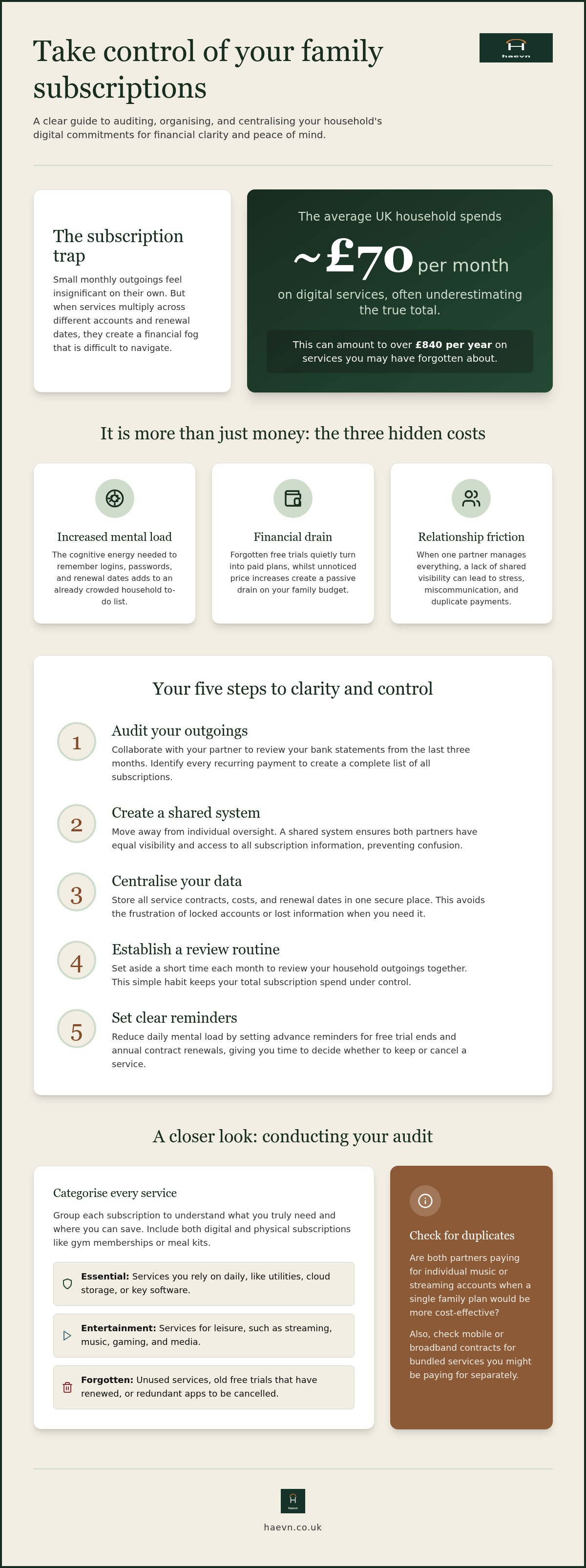
Many of us significantly underestimate our actual outgoings. It is easy to lose track when payments are scattered across different bank accounts and various renewal dates. You likely feel the quiet friction of a forgotten free trial turning into a full-price charge or the minor annoyance of asking your partner for a login code yet again. Managing family subscriptions often feels like a secondary job, adding to an already crowded mental load.
We understand that household admin should be clear and collaborative rather than a source of domestic tension. This guide explains how to take control of your finances by auditing, organising, and centralising your digital commitments. You will learn how to create a shared view of your total monthly spend and build a secure system that both partners can access. By following these steps, you can reduce unnecessary costs and bring a sense of order to your household's digital landscape.
Key Takeaways
- Audit your bank statements from the last three months to identify forgotten renewals and quiet price increases.
- Move away from individual oversight to a shared system for managing family subscriptions to ensure both partners have equal visibility.
- Centralise all service contracts and renewal dates in one secure place to avoid the frustration of locked accounts or lost information.
- Establish a simple monthly routine for reviewing household outgoings to keep your total subscription spend under control.
- Reduce the daily mental load by setting clear reminders for free trial ends and annual contract renewals.
The true cost of fragmented family subscriptions
Many households fall into a subscription trap where small monthly outgoings feel insignificant. A £5.99 streaming tier or a £8.99 delivery pass doesn't trigger an alarm on its own. However, when these services multiply, they create a financial fog. The rise of the subscription business model means we now rent our entertainment, software, and even our groceries, often without a clear view of the cumulative total.
In a British household, the mental load isn't just about the money. It's the cognitive energy required to remember which email address is linked to the Disney+ account or when the annual Amazon Prime renewal is due. This administrative weight often falls on one person, leading to quiet resentment and unnecessary stress. Friction frequently arises when partners lack visibility into shared finances. If you don't know what your partner is paying for, you might accidentally pay for a duplicate service or miss a price hike. Subscription fragmentation is the scattering of household services across different accounts and platforms.
Why visibility is the first step to order
Clarity is more valuable than a few pounds saved. When you have a single source of truth, you stop guessing. You can see that you're paying for three different music services and decide which one to keep. This visibility turns a source of stress into a manageable list. A household audit shouldn't be a solo burden; it's a collaborative task that helps both partners understand where the money goes. Knowing exactly what you pay for provides psychological relief that a messy bank statement cannot offer.
The financial impact of forgotten renewals
Free trials often serve as a doorway to forgotten costs. They transition into paid plans without a clear notification, catching busy families off guard. Over a year, these small, recurring charges become a significant drain on the family budget. This lack of tracking is a form of passive household waste. It's money leaving your account for services you no longer use or value. Effectively managing family subscriptions requires a proactive approach to stop these leaks before they accumulate into hundreds of pounds of lost income.
Identifying and auditing your household services
The first step toward order is a thorough review of your outgoings. To begin, gather your bank statements from the last three months. This timeframe is specific enough to catch monthly payments whilst being long enough to identify quarterly or annual renewals that might otherwise slip through. You should look for any recurring transaction, no matter how small, as these are the building blocks of your total spend. A joint review with your partner is essential here. It means that services paid for from different accounts are brought into the light, allowing for a complete picture of the household's digital commitments.
During this audit, you should categorise every service into three groups: essential, entertainment, and forgotten. Essential services include utilities or cloud storage used for family photos. Entertainment covers streaming and gaming. The forgotten category is for those free trials that rolled over or services you no longer use. Using clear tips for managing subscriptions can help you decide what stays and what goes. This process turns a confusing list of transactions into an actionable plan for managing family subscriptions effectively.
Categorising your digital and physical subscriptions
Subscriptions aren't limited to what you watch on a screen. Digital services like news sites, productivity tools, and cloud backups are common, but physical subscriptions often carry higher costs. Gym memberships, wine clubs, and meal kits frequently go under the radar because they feel like lifestyle choices rather than administrative items. Grouping these together allows you to see the total volume of your commitments. You might find that you're paying for a premium fitness app whilst also maintaining a full gym membership you rarely visit. Consolidation becomes much easier once these overlaps are visible.
Spotting the duplicates in your family group
Duplicate services are a common source of waste in dual-income households. You might discover that both partners are paying for individual music streaming accounts when a single family plan would be more cost-effective. Look for overlapping content libraries across different video platforms. It's also wise to check your mobile phone or broadband contracts for bundled services. Many providers include "free" subscriptions to major streaming platforms as part of their packages. If you're paying for these separately, you're essentially being charged twice for the same access. Identifying these redundancies is a simple way to reduce your monthly outgoings without losing any services you enjoy. Once you've identified your active services, you can begin centralising your household data to maintain this clarity for the long term.
Creating a shared system for subscription visibility
Managing family subscriptions effectively requires moving beyond the 'mental spreadsheet' of a single person. Relying on one partner's memory creates a significant point of failure for the whole household. If the person who holds all the login details and renewal dates is unavailable, the administrative side of the home grinds to a halt. A central, digital space for service details and login methods is a cornerstone of managing family subscriptions, ensuring that both partners can access information whenever it is required. This shared visibility reduces the need for constant verbal updates, meaning you don't have to interrupt each other's day to find out when a contract ends or how much a service costs. When everyone knows where the information lives, the anxiety of a forgotten password or a missed payment notification disappears. It turns a potential source of domestic friction into a simple, quiet process of checking a shared record.
Shared access versus shared responsibility
It is helpful to distinguish between who uses a service and who manages the admin. While the whole family might use a streaming platform, only one person might handle the payment. However, visibility should be universal. Both partners should be able to view renewal dates and costs at any time to maintain a clear picture of the household outgoings. This level of transparency means that neither person is surprised by a charge appearing on a bank statement. You can organise family finances with a monthly budget app to help maintain this level of oversight without the friction of manual spreadsheets or fragmented notes. Having a single source of truth means that administrative tasks become a shared partnership rather than a solo burden.
The security of shared logins and data
Sharing passwords via unencrypted chat apps or leaving them on paper notes in the kitchen drawer poses a significant security risk. These methods are easily compromised and offer no real protection for your digital life. Instead, use a system built to UK GDPR standards to keep your household data secure. Managing your family's digital footprint safely means using tools that prioritise privacy and encryption over convenience. This protective approach means that your sensitive information remains within the household's private sphere while still being accessible to those who need it. It is particularly important for services that store your payment card details or personal addresses. A secure, centralised system acts as a guardian for your private information, allowing you to share access with your partner without compromising your digital safety.
Reducing the mental load of monthly renewals
The mental load of running a home is often invisible until it becomes overwhelming. Much of this weight comes from the constant background noise of administrative deadlines. When you are managing family subscriptions, the challenge isn't just the cost; it's the cognitive energy required to track disparate renewal dates. Establishing a monthly routine for reviewing these outgoings can quiet this noise. By setting clear reminders, you stop the cycle of unwanted charges appearing on your bank statement. Placing every renewal date in a shared calendar means that neither partner is caught off guard. Think of this process as a form of digital tidying that clears the path for a more organised life.
Managing the renewal cycle as a team
A simple 10-minute check-in once a month is often all that is needed to maintain order. During this time, you and your partner can look at the upcoming month's renewals together. This isn't about interrogation; it's about seeing the big picture of your household's daily life and commitments. Discussing these items openly helps you decide if a service still provides value. You might find that is the Haevn Monthly Plan the right choice for your family as it centralises these administrative tasks into one shared view. This collaborative approach turns a solo burden into a shared responsibility, making the household run more smoothly.
Cancellation as a routine household task
Adopting a 'cancel first' mindset is an effective way to keep your digital life lean. If a service hasn't been used in 30 days, it's likely no longer serving your household's needs. There is often an emotional resistance to cancelling, perhaps a feeling that you might need it 'one day' or a sense of loss for the content you're giving up. However, viewing cancellation as a routine part of household maintenance helps overcome this hurdle. A tidy digital life leads to a calmer home environment because there are fewer things to track, monitor, or pay for. When you remove the clutter of unused apps and services, you regain both your money and your mental space. You can start your household audit today to begin tracking your renewals in one secure place.
How Haevn helps with this
Haevn is a central hub for British families who want to reclaim their time and mental energy. It moves household management from fragmented notes and individual banking apps into a single, shared space. When you are managing family subscriptions, you need a reliable place for the facts to live. Haevn provides this by centralising your admin in a way that is accessible to the whole household.
Pot is designed for this level of oversight. It allows for the manual entry of subscription costs, giving you a clear view of your total monthly outgoings. Unlike automated tools that can feel invasive, manual entry means you remain in control of the data and are fully aware of every pound leaving the household. For storing the finer details, House serves as a digital filing cabinet. You can keep service contracts, account IDs, and warranties here, ensuring you never have to hunt through a cluttered inbox again. It is important to be clear about what the app does not do: Haevn will not automatically cancel subscriptions for you. You retain the final say and must handle cancellations directly with the service providers.
Centralising your household admin
Access is a shared right in a modern home. Haevn allows up to eight family members to view and update the same household information, ensuring everyone is on the same page. Features like Home provide a clear dashboard for the family's day, showing you exactly what needs your attention. This collective approach removes the burden from a single person and fosters a sense of partnership. Privacy is at the core of the experience. The app is built to UK GDPR standards, and we never sell family data to third parties. Your household's private sphere remains exactly that: private.
A single price for a sorted home
Order shouldn't come with a complex pricing structure. Haevn offers one straightforward plan at £6.99 per month or £69.99 per year for the entire family. It is designed for the way whole families live, providing a composed and capable space to manage the chaos of domestic life. By centralising your efforts in managing family subscriptions alongside other daily tasks, you reduce the mental load and create a more harmonious home environment.
Moving toward a more organised household
Taking control of your digital outgoings is more than just a budgeting exercise; it's a way to reclaim your mental space. By auditing your bank statements and moving toward a shared system of visibility, you remove the quiet friction that fragmented admin creates. Managing family subscriptions doesn't have to be a solo burden or a source of domestic tension when the whole household can access the same information.
Building a central hub for your family's data means that renewal dates and service contracts are always within reach. Haevn offers a privacy-first design built to UK GDPR standards, providing one plan for the whole family. You can begin simplifying your household management today without the need for complex spreadsheets or forgotten passwords.
Start your free trial. 14 days free, no card needed
Establishing these new habits will lead to a calmer, more coordinated home environment.
Frequently Asked Questions
How can I see all my family subscriptions in one place?
You can see all your outgoings in one place by conducting a thorough audit of your bank statements from the last three months and centralising the results. Using a dedicated tool like Pot allows you to manually enter every subscription cost, creating a single source of truth for the household. This method means that services paid from different accounts are visible to both partners. It provides a clear overview of your total monthly spend without needing to check multiple banking apps.
Is it safe to share subscription login details with my partner?
Sharing login details via unencrypted chat apps or paper notes is not secure. A safer approach is to use a platform built to UK GDPR standards that prioritises privacy and encryption. Features like House allow you to store service contracts and account details in a secure, shared space. This means your data remains within the household's private sphere whilst remaining accessible to both partners. It removes the risk of sensitive information being compromised through insecure digital channels.
What is the best way to track annual subscription renewals?
The most effective way to track annual renewals is by using a shared family calendar with built-in reminders. You should record the renewal date as soon as you sign up for a service, including any 14-day cooling-off periods or free trial end dates. Using Plan means that both partners receive notifications before a charge is applied. This proactive approach to managing family subscriptions stops forgotten annual fees from catching the household budget off guard during the year.
How do I reduce the cost of our family subscriptions?
Reducing costs begins with identifying duplicate services and overlapping content libraries. You should look for opportunities to move individual accounts onto a single family plan, which often provides better value for up to eight members. Check your mobile or broadband contracts for bundled services you might already be paying for separately. Adopting a 'cancel first' mindset for any service not used in the last 30 days will help stop passive waste and lower your total monthly outgoings.
What should I look for in a family management app?
You should look for an app that prioritises privacy and is built specifically for how whole families live. It should offer a single flat rate of £6.99 per month for the entire household rather than charging per user. Ensure the platform adheres to UK GDPR standards and has a clear policy against selling your data. Useful features include a shared dashboard like Home and dedicated spaces for budgeting and bill management. Avoid apps that feel like corporate tools.
Can I manage subscriptions for a multi-generational household?
Yes, managing family subscriptions for a multi-generational home is straightforward with the right household hub. You can add up to eight members to a single plan, allowing grandparents or adult children to access shared information.