Joint budget app for UK couples: Finding the right fit
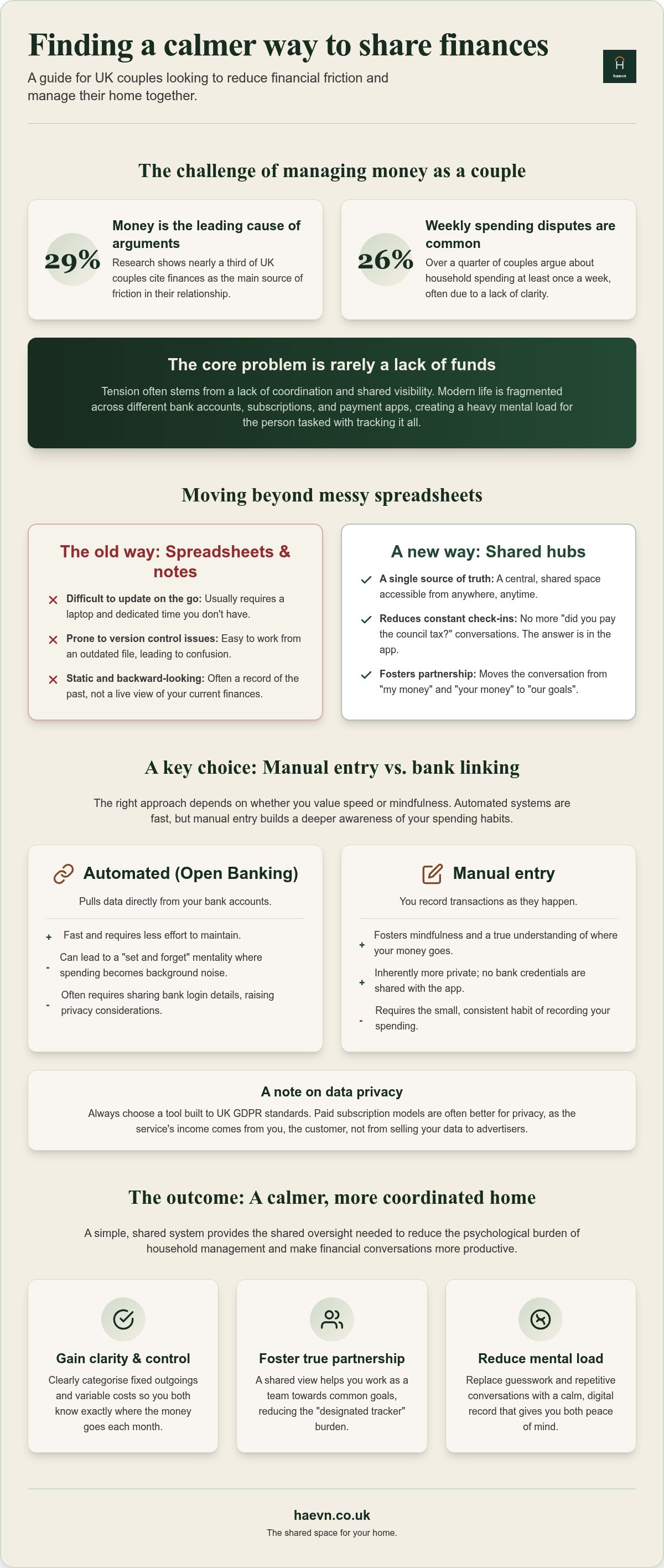
Money is a common source of arguments for couples. These tensions often stem from a lack of clarity rather than a lack of funds. Managing a modern home is complex. It is exhausting to bounce between different banking apps just to see if the electricity bill has cleared or who paid for the grocery shop.
Choosing a joint budget app for couples UK doesn't have to be another chore on your list. This guide will help you find a tool that brings transparency to your finances and removes the mental load of tracking subscriptions and irregular costs. We will look at how to move away from messy spreadsheets and towards a calm, shared oversight of your household money. You'll learn how to select a system that fosters partnership, reduces the time spent on monthly reviews, and means you both know exactly where the money goes.
Key Takeaways
- Understand how fragmented digital accounts increase the mental load and why a single source of truth helps.
- Learn to distinguish between dedicated finance tools and integrated household hubs to find the right joint budget app for couples UK.
- Follow a simple framework for categorising fixed outgoings and variable costs to make monthly reviews calmer.
- Discover why manual entry and a privacy-first approach foster better financial mindfulness than automated systems.
- Gain clarity on your spending to reduce friction and make financial conversations more productive.
The challenge of managing money as a UK couple
Most UK households don't suffer from a lack of income as much as a lack of coordination. When two people share a life, they often bring two separate ways of thinking about money. One might be a meticulous planner whilst the other prefers a more fluid approach. This mismatch often leads to the financial admin falling on one partner by default. It creates an invisible imbalance in the mental load of the home. This person becomes the "designated tracker," responsible for every direct debit and grocery receipt.
Modern spending is fragmented. Between high street accounts, digital neobanks, and various subscription services, getting a clear view of a household budget feels like a full-time job. Moving from individual spending to shared responsibility requires a system that reflects how you actually live. Traditional methods like paper lists or basic notes on a phone lack the structure needed to handle irregular expenses or upcoming bills. Using a dedicated joint budget app for couples UK can bridge this gap by providing a central point of truth for both partners.
Moving beyond separate spreadsheets
Many couples start with a spreadsheet. It feels like a logical step, but spreadsheets are often static and difficult to update whilst you're on the move. They require a laptop and a specific block of time that most busy couples don't have. Version control issues are common. If one partner updates the file and the other doesn't see the latest version, you end up with confusion regarding the actual household balance. You can read more about why spreadsheets fail for family budgets to understand why these manual files often end up abandoned.
The psychological weight of financial admin
Financial stress is a common cause of friction in relationships. When money is opaque, arguments usually follow. A shared view of your finances helps you move from "my money" to "our goals." It isn't just about the numbers; it's about the peace of mind that comes from mutual awareness. A joint budget app for couples UK provides this shared oversight without the need for constant, exhausting verbal check-ins. It replaces the "did you pay the council tax?" conversation with a calm, digital record that both partners can access at any time. This shared awareness reduces the psychological burden of household management.
How shared budgeting apps actually work
A shared budgeting app is more than a simple calculator. It functions as a digital space where couples can record, categorise, and review their household spending in real time. Instead of waiting for a monthly bank statement or trying to remember what a specific transaction was for, these tools provide a central point of truth. They allow you to see exactly what is left for groceries, bills, and shared savings goals without having to ask your partner for an update.
Most options on the UK market fall into two distinct categories: automated or manual. Whilst many budgeting apps rely on bank syncing, others focus on active participation. The right joint budget app for couples UK should balance shared visibility with individual privacy, ensuring you can manage the home without losing your personal financial autonomy.
This provides speed, but it often leads to a "set and forget" mentality. When transactions appear automatically, they can become background noise. You might stop noticing small, recurring costs that eventually drain your balance. Manual entry takes a different approach. By recording transactions yourself, you develop a deeper understanding of your spending patterns. This deliberate action encourages mindfulness and helps you stay connected to your financial goals. Manual systems are also inherently more private because they don't require your bank login details to function.
Privacy and data security in the UK
Data security is a non-negotiable requirement for any financial tool. You should ensure any joint budget app for couples UK you consider is built to UK GDPR standards. Some free apps make money from advertising, so read the privacy policy of any app you consider. A paid subscription model is different. It creates a clear relationship where you are the customer, not the product. If you value a private, mindful approach to managing your home, you can create your shared space to begin organising your finances with more intention.
Choosing between dedicated finance apps and household hubs
Choosing a joint budget app for couples UK often involves a choice between depth and breadth. Dedicated finance apps focus strictly on numbers, transactions, and balances. They provide detailed charts but often exist in a vacuum, disconnected from the daily reality of your home. Household hubs take a different approach by integrating budgeting with your calendar, chores, and meal planning. For a busy couple, the primary goal is often to reduce the friction of daily life. This means minimising the number of notifications, logins, and separate platforms required to stay organised.
Feature fatigue in standard banking apps
Many UK banks now offer basic budgeting tools within their own mobile apps. Whilst these are helpful for a quick check of your balance, they are often restricted to a single bank. If your household finances are spread across multiple providers, these tools cannot provide a unified view. They also tend to lack effective collaboration features. One partner might have oversight, but the other remains in the dark. Third-party apps provide a broader perspective, pulling together data from various institutions into a single, shared interface. This means both partners have equal access to the same information without having to share login details.
Why transparency beats automation
Automation is frequently suggested as a way to simplify your life, but it can sometimes hide financial waste. When everything is automated, it is easy for "zombie" subscriptions to drain your account for months without being noticed. You can learn more by reading our guide to managing family subscriptions. Transparency encourages you to look at your outgoings with fresh eyes. This clarity is especially useful for irregular household expenses, such as car repairs or school trips. When both partners have a clear view of upcoming costs, you can plan together rather than reacting to surprises. This shared oversight moves the conversation from "where did the money go?" to "how shall we use what we have?". Finding a joint budget app for couples UK that prioritises this shared visibility helps build a more resilient financial partnership.
Setting up your shared financial system
Success with a shared budget depends on a clear structure. Start by identifying the non-negotiables. List every fixed outgoing that leaves your account on the same date each month. Rent, mortgage, council tax, and utilities are the obvious foundations. Once these are accounted for, agree on a weekly allowance for shared variable costs. Groceries and fuel are the most common areas where spending can drift if not monitored. A joint budget app for couples UK helps you see these figures clearly without having to dig through your banking history.
Set aside time once a month for a calm review of the household finances. This isn't about restriction; it's about awareness. Adjust your categories as your family needs change. What worked for you last year might not fit your current lifestyle, especially if you have recently moved house or changed jobs. To begin building your own system, you can set up your household hub today.
Defining your household pots
Most families find success by grouping expenses into manageable categories. These should be simple enough to use daily but detailed enough to be useful. In our experience, the following categories provide a solid starting point:
- House: Mortgage, rent, council tax, and utilities.
- Groceries: The weekly shop and occasional top-ups.
- Kids: School fees, clubs, and clothing.
- Leisure: Dining out, cinema trips, and shared hobbies.
You might also want to include a specific category for irregular costs. These are the expenses that only happen once or twice a year, such as car insurance or holiday bookings. You can read more about tracking irregular household costs to see how to manage these without breaking your monthly plan.
Building a sustainable money routine
Timing is everything. Avoid checking the budget during moments of high stress, such as right before bed or in the middle of a busy workday. Instead, set aside a specific time when you are both relaxed. Use your joint budget app for couples UK to record expenses the moment they occur. This small habit keeps your data accurate and helps avoid the mental load from building up at the end of the week. Focus on progress and awareness rather than strict restriction. The goal is to understand where your money goes so you can make intentional choices together. When you both have a clear view of Pot, financial conversations become much calmer.
How Haevn helps with this
Haevn is designed to be a calm and private space for UK couples to manage their home. It is not just another utility; it is a central point of origin for everything that keeps your household running. By centralising Plan, Pot, and Lists in a single interface, it reduces the mental load of switching between fragmented apps. This integrated approach means that your finances are always viewed in the context of your wider life. The design avoids the frantic energy of typical productivity tools, opting instead for a warm British aesthetic that feels like a home rather than corporate software.
Privacy is the foundation of the experience. We believe your household data belongs to you, which is why Haevn is built to UK GDPR standards. We never sell your data to advertisers or use your spending habits to pitch credit cards. Privacy is a big part of why couples choose Haevn as a joint budget app. It provides the oversight you need without the invasive data-sharing required by many other digital platforms.
Pot: Shared awareness without the clutter
Pot is our answer to the transparency problems discussed earlier. It uses a manual entry system to give you full control over your financial data. This deliberate design encourages mindfulness. When you record a transaction yourself, you stay connected to your spending patterns in a way that automated systems often discourage. It is a tool built for the way British families actually live, providing a clear view of where the money goes whilst maintaining individual privacy. Honesty is paramount, so we're clear about what the app doesn't do. Haevn does not offer automated bank syncing, investment tracking, or credit score monitoring. It is a coordination tool, not a financial services platform.
One price for the whole household
We believe in straightforward pricing without hidden tiers or individual user plans. Haevn costs £6.99 a month or £69.99 a year for your entire household. Up to 8 members can join under a single subscription via People, allowing everyone in the home to stay aligned. We do not offer a free tier. This is a deliberate choice to ensure your data remains your own and our interests remain aligned with yours. By paying a flat rate, you ensure that the app remains a private, ad-free environment for your family. This model suits couples who prefer a paid, ad-free app.
Building a calmer financial future together
Managing household money doesn't have to be a source of friction. By moving away from fragmented accounts and towards a single point of truth, you can reduce the mental load of daily admin. A joint budget app for couples UK provides the shared oversight needed to move from individual spending to collective awareness. Choosing a tool that prioritises privacy and mindfulness means your data remains secure whilst you build better habits together.
A sustainable system is one that fits your actual life, connecting your finances with your schedule and chores. Haevn offers a private, ad-free environment built to UK GDPR standards. With one plan for up to 8 family members and no data selling, it provides a safe haven for your household admin. You can begin this journey today without complex setup or invasive bank links.
Start your free trial. 14 days free, no card needed
Taking the first step towards financial transparency is often the hardest part, but the clarity that follows makes every conversation easier.
Frequently Asked Questions
Does a joint budget app require a joint bank account?
No, a joint budget app does not require a joint bank account. Most tools allow you to track shared expenses regardless of where the money is held. You can use a joint budget app for couples UK to log spending from individual accounts, credit cards, or cash. This helps couples who prefer to keep their banking separate whilst maintaining a central view of all household costs.
Is it better to use an automated or manual budget app in the UK?
It depends on whether you value speed or mindfulness. Automated apps save time by syncing with your bank, but they can lead to a passive habit where transactions go unnoticed. Manual entry encourages you to look at every cost, which helps you stay mindful of your spending patterns. If you want better financial control and strict privacy, manual entry is often the better choice for your home.
How do couples divide bills fairly using an app?
Couples often divide bills by percentage based on their incomes or by splitting fixed amounts. You can use your shared app to record who paid for specific items and then settle any difference at the end of the month. Using a central digital space means both partners see the total outgoings. This makes it easier to agree on a fair contribution for rent, utilities, and the weekly grocery shop.
Can we keep some of our spending private whilst using a shared app?
You can keep your individual spending private because you only record what you choose to share. Since Haevn uses manual entry, you decide which transactions enter Pot. This allows you to maintain clear oversight of the household budget whilst keeping personal spending private. It provides a balance between shared transparency and individual autonomy without the need for invasive bank links that track every purchase.
What is the best way to track irregular yearly expenses?
A practical approach is to create a specific category for non-monthly costs such as car insurance, boiler services, or annual holidays. Estimate the total for the year and divide it by twelve to see your monthly requirement. Recording these irregular expenses in your joint budget app for couples UK means they don't become a surprise. This method helps you have the funds ready when these larger bills eventually arrive.
How long does it take to set up a shared budget in Haevn?
Setting up your household hub usually takes about fifteen minutes. Once you have created your account and invited your partner in People, you can begin listing your main categories in Pot. Adding your fixed monthly outgoings like rent or council tax is a sensible place to start. The design is clear, so you don't need to be tech-keen to get organised.