How to stop arguing about chores with your partner
Arguments about household tasks are common between partners. If you have been wondering how to stop arguing about chores with partner, you likely know the exhaustion of being the only person who notices the bin needs emptying or that the fridge is nearly bare. This constant state of alertness often leads to a cycle of nagging and resentment that leaves both people feeling drained.
You want a home that feels like a sanctuary rather than a source of conflict. Solving this tension starts with acknowledging that the problem usually isn't the cleaning itself. It's the unequal distribution of the mental load and the invisible work required to keep a household running. When one person carries the weight of planning whilst the other simply waits for instructions, the partnership feels more like a management role than a shared life.
This article explores how to move past the chore war by identifying hidden labour and establishing a shared household system. We will look at practical ways to divide responsibilities fairly so you can reduce mental fatigue and enjoy a more peaceful environment together.
Key Takeaways
- Understand that conflict often stems from the mental load of noticing and planning rather than physical tasks.
- Discover how to stop arguing about chores with partner by making all invisible labour visible through a household audit.
- Shift from individual scorekeeping to a shared system that reduces mental fatigue for everyone.
- Move away from resentment by establishing a consistent weekly household check in.
- Assign responsibilities based on personal preference and skills to ensure a fairer division of work.
Understanding why household chores cause relationship conflict
Arguments about the kitchen sink or the laundry pile are rarely just about the dishes or the clothes. In many busy British homes, these disputes are a symptom of a deeper imbalance in how work is perceived and valued. These "chore wars" often stem from a fundamental disagreement over what needs to be done and when, leading to a breakdown in communication between otherwise happy couples.
The friction usually happens because of invisible labour, which is the mental effort required to manage a household. This includes the constant scanning of the environment to identify what is missing, broken, or overdue. When one partner carries this cognitive weight alone, relationship satisfaction often drops. Understanding how to stop arguing about chores with partner requires looking past the physical task to the mental energy spent planning it.
The impact of differing household standards
One partner might walk into a room and notice the dust on the skirting boards, whilst the other sees a perfectly functional living space. This gap in perception is not usually a sign of laziness. It is often a difference in "clutter thresholds". When these standards do not align, the partner with the higher standard often falls into a cycle of nagging. This creates a parent-child dynamic that is damaging to romantic partnerships. Peace is only possible when both people agree on a baseline level of cleanliness that they can both maintain together.
Moving away from the concept of helping out
Language matters in domestic life. When a partner asks how they can "help out" with the cleaning, they are inadvertently suggesting that the responsibility belongs to someone else. This implies that one person is the project manager and the other is merely a volunteer. For a partnership to feel fair, both people must own the outcome of the household. This shift in mindset moves the conversation from doing a favour to managing a shared life. If you find this dynamic extends to the rest of the family, you might also find it useful to read about how to stop nagging kids to do chores.
Defining invisible labour and the mental load
Most households struggle because work is only visible when it isn't done. Invisible labour is the hidden management that keeps a home functional. It is the mental list of upcoming birthdays, the knowledge of which school jumper is clean, and the awareness that the boiler is due for a service. Even when both partners work equal hours, this cognitive burden often skews heavily toward one person. Research indicates that this persistent imbalance often hurts your relationship by fostering deep-seated resentment.
The mental load is not just about the tasks themselves. It is the exhaustion of being the person who has to remember they exist. When you are looking for ways for how to stop arguing about chores with partner, you must first define what is actually being done. You cannot divide what you cannot see.
The three stages of household management
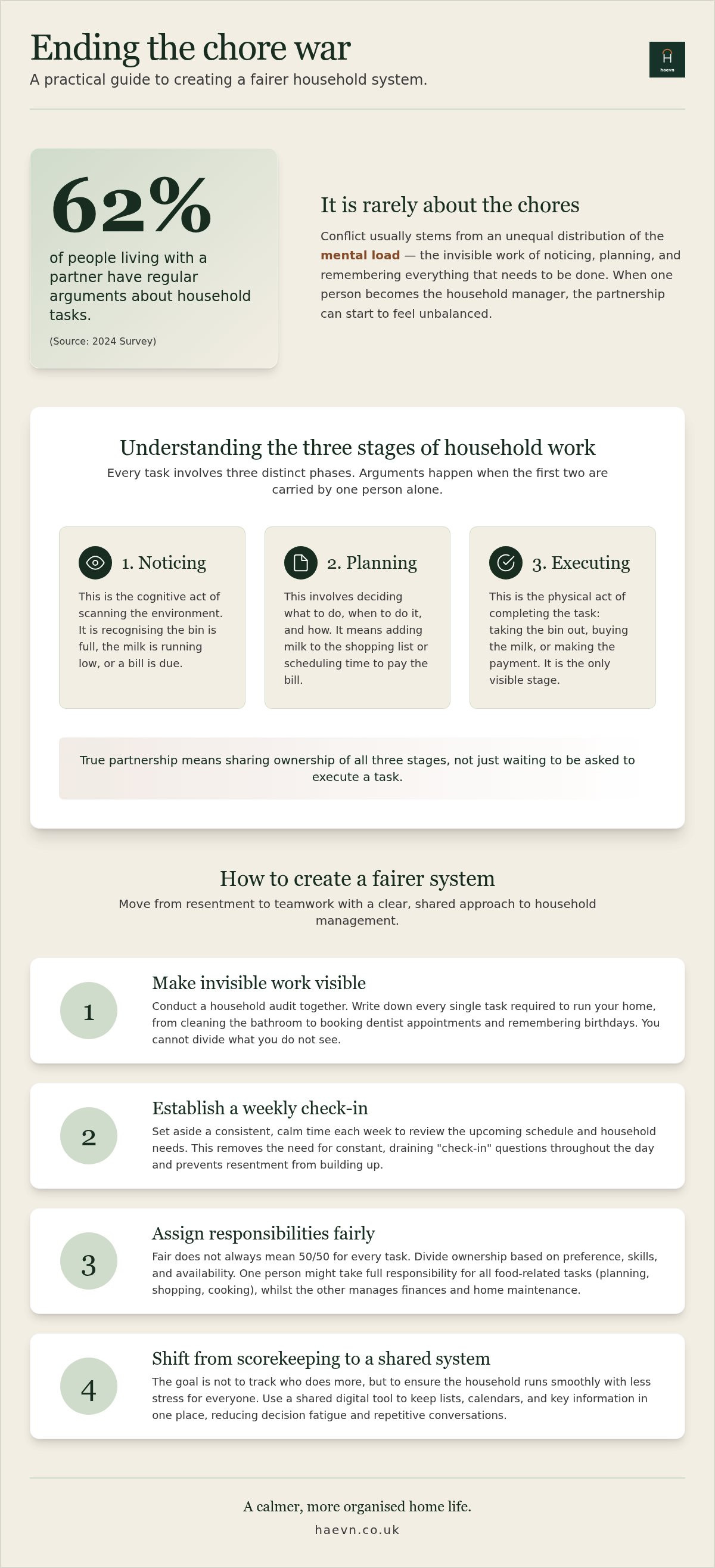
Every chore consists of three distinct phases. Most people only give credit for the final one. To achieve a fair balance, you must recognise all three:
- Noticing: Recognising that the bathroom floor is sticky or that the dog is low on kibble.
- Planning: Deciding which cleaning products to buy or finding time in the schedule to mop before guests arrive.
- Executing: The physical act of scrubbing the floor or going to the shop.
Conflict occurs when one partner handles the noticing and planning whilst the other only waits for the execution phase. This leaves one person feeling like a project manager and the other like a reluctant helper.
Why decision fatigue leads to conflict
By the time you return home from a day of work, your capacity for making choices is often depleted. This is decision fatigue. When a partner asks "what's for dinner?" or "where did you put the spare key?", it can feel like a demand on your remaining energy. These small questions accumulate throughout the day, leading to a state of total mental depletion by 7 PM.
This exhaustion is why evening arguments can escalate so quickly. When you are both tired, a simple query about the laundry can feel like an attack. Centralising your household information in a shared digital space reduces the need for constant verbal updates and "check-ins". You can set up a shared household hub to remove the friction of these daily questions and protect your evening peace.
A step by step guide to fair chore division
Moving from frustration to a functional system requires more than a conversation; it requires a process. If you want to know how to stop arguing about chores with partner, you must start by making the invisible visible. This transition is not about achieving a perfect 50/50 split of every minute, but about reaching a point where both people feel the distribution is fair and sustainable.
Conducting a household audit
The first step is to document every single recurring task that keeps your life moving. This audit should cover everything from the obvious, like vacuuming, to the administrative, such as booking dental appointments, renewing car insurance, or managing school holiday schedules. Use Lists to document these items in a shared space where both partners can see them. This removes the need for one person to be the sole keeper of all household information.
When auditing, you must account for the frequency and the time required for each entry. Emptying the dishwasher takes five minutes but happens daily; cleaning the oven takes an hour but happens once a month. You must also include the noticing work discussed earlier. For example, the person who cleans the bathroom should also be responsible for noticing when the bleach is low and adding it to the shopping list. By documenting the noticing and planning stages alongside the physical execution, the mental load is finally acknowledged and accounted for.
Choosing tasks based on preference
Efficiency often comes from interest. If one partner finds ironing meditative whilst the other finds it infuriating, the division should reflect that. Assigning tasks based on preference and skill, rather than traditional gender roles or a rigid sense of equality, leads to better outcomes. You might decide to swap tasks entirely if one person feels they have been stuck with the low-reward chores for too long. This negotiation means that neither person feels their time is valued less than their partner's.
Once you have a new plan, agree to a trial period of two weeks. This allows you to test the system without the pressure of it being permanent. It also provides a natural opportunity to adjust the plan if certain tasks turn out to be more time-consuming than expected. Establishing this clear system of accountability means that tasks get done because they are owned by a specific person. This removes the need for nagging or constant reminders, as the expectation is set before the work begins.
Moving from scorekeeping to a shared household routine
Scorekeeping is a common reaction for those trying to figure out how to stop arguing about chores with partner, but it rarely leads to a peaceful home. Tracking every minute of labour turns a relationship into a transactional exchange where someone is always winning and the other is losing. This mindset breeds resentment because it ignores the reality of a busy life. Some weeks, one person will have more capacity than the other. True fairness is about the long-term balance of the mental load rather than a daily stopwatch.
Ultimately, how to stop arguing about chores with partner requires moving away from tally-taking and toward a shared routine. This shift requires trust and visibility. When you both know what needs to be done and who is doing it, the urge to monitor each other's activity vanishes. Focus on the outcome of a tidy, functional home rather than the specific minutes spent achieving it.
The weekly household check in
A structured 15-minute meeting every Sunday evening can stop a week of friction before it starts. This is the time to review Plan and look at the days ahead. Life in a dual-income household is rarely static. You might have a late shift on Tuesday, or the children might have a school play on Thursday. These changes affect your household's capacity to handle chores.
During this check in, adjust the responsibilities for the week. If one person is particularly stretched, the other can pick up the slack without it feeling like a personal favour. This proactive approach means that the noticing and planning stages are handled together. You'll find it easier to agree on who will handle the food shop on a calm Sunday than to fight about it on a stressed Monday evening.
Using shared lists to stay aligned
Visibility is the most effective antidote to nagging. When a chore list is stuck in one person's head, they are forced to act as the manager. A shared digital list removes this requirement entirely. If you can see that the bins have been emptied or the milk has been bought in real time, you don't need to ask. This transparency reduces the number of small logistical questions that contribute to decision fatigue.
This system also allows for spontaneous contributions. If you find yourself with an unexpected ten minutes, you can check the list and complete a task that fits that window. Acknowledging the work done by others is also vital. A simple thanks for sorting the laundry goes a long way in making a partner feel seen and valued. You can set up your shared household routine to move away from scorekeeping and toward genuine partnership.
How Haevn helps with this
Managing a home is a collective responsibility that requires a central point of origin. Haevn centralises your household management into one calm digital space designed for capable adults. It is not a work tool, a parenting app, or a tracker. Instead, it provides a dedicated environment for the whole home to stay aligned. If you have been looking for how to stop arguing about chores with partner, moving your domestic logistics out of group chats and into a single hub is the most effective step you can take.
Visibility through Lists and Plan
The core of the system lies in making the invisible work visible. Lists allows you to document every task, from the daily dishes to the annual boiler service. By assigning chores within Lists, you establish clear ownership. This removes the ambiguity that often leads to conflict. When a task is owned by a specific person, the noticing and planning stages are no longer a source of tension. It is clear who is responsible for the outcome.
Plan coordinates the wider family schedule, ensuring everyone knows what is happening and when. This visibility helps avoid the decision fatigue that often leads to evening arguments. You no longer need to ask what is for dinner or when the window cleaner is due. Up to 8 members can stay coordinated under a single subscription, so everyone in your household can see the same information. Whilst Haevn provides the structure for a well-ordered home, it does not offer automated reminders for every minute task or use points to reward chores. It assumes you are a capable adult who simply needs a clear overview.
A privacy first approach to family life
Trust is a fundamental requirement for any shared digital space. Haevn is a privacy-first platform built to UK GDPR standards. Your household data is protected and kept private within your household. We do not sell your personal information to third parties, and the app does not use intrusive adverts. This creates a safe haven for your domestic data away from the data-mining practices often found in other tools.
The pricing is straightforward. We offer a single flat rate of £6.99 a month or £69.99 a year for the entire household. There is no free tier and no hidden fees. This simple approach reflects our commitment to being a reliable partner in your household management.
Building a shared household system
Reclaiming peace at home starts with acknowledging that the chore war is rarely about the laundry itself. It is about the mental fatigue of being the only person who notices what needs doing. When you understand how to stop arguing about chores with partner, you move away from scorekeeping and toward a collective routine. This requires making all invisible work visible and assigning ownership based on capacity rather than tradition.
A functional home relies on shared visibility. By conducting a household audit and establishing a weekly check in, you can reduce the decision fatigue that leads to evening friction. This structured approach means that both partners feel valued and that household management is a shared partnership rather than a management role.
Haevn provides one place for every part of family life with a privacy-first design built to UK GDPR standards. There are no per-user fees, just a single flat rate for your household. Start your free trial. 14 days free, no card needed.
Frequently asked questions
How do I talk to my partner about chores without arguing?
Start the conversation when you are both calm rather than in the heat of a mess. Use "I" statements to explain how the mental load affects your energy levels. Avoid listing past failures or tallying old scores. Instead, focus on the future and the desire for a shared system that works for both of you. A scheduled 15-minute weekly check in provides a neutral, structured space for these discussions without the pressure of an immediate crisis.
What is the most fair way to split household chores?
Fairness is rarely a 50/50 split of every physical task. The most effective approach is to divide responsibilities based on total available time and personal preference. If one person works longer hours, the other might handle more daily execution, but the mental load of planning should still be shared. Use a full household audit to ensure every job is visible before you begin the negotiation. This means both people feel the distribution is sustainable.
How do you deal with a partner who does not do their share of chores?
Address the root cause by discussing the noticing and planning stages of each task. Often, a partner doesn't do their share because they are waiting for instructions. By making the full list of requirements visible in a shared digital space, you remove the excuse of not knowing what needs doing. If the imbalance persists, revisit your agreement during your weekly meeting to identify specific friction points and adjust ownership based on current capacity.
Why do we keep arguing about the same chores every week?
Recurring arguments usually happen because the underlying system has failed. You might agree on who does the laundry but not on the standard of "done". If you are looking for how to stop arguing about chores with partner, you must define the full cycle of the task. This includes everything from sorting the clothes to putting them away in the correct drawer. Clear ownership removes the ambiguity that leads to repetitive weekly friction.
Is there an app to help couples manage chores?
Haevn is built for this kind of shared household routine. It centralises household management into one hub, using Lists to track chores and Plan to coordinate the family schedule. Unlike general productivity tools, it focuses on the unique needs of a household. It provides a privacy-first environment where up to 8 members can stay aligned without the need for constant verbal reminders or nagging. One plan at £6.99 a month or £69.99 a year covers the entire household.
How can we divide chores when one partner works more hours?
Focus on equitable leisure time rather than an equal number of physical tasks. The partner with fewer work hours might take on more execution, but the mental load of management should remain a collective effort. This means that when both partners are finally home, they have a similar amount of free time to rest. Adjusting this balance during a Sunday check in helps account for changing work schedules and helps avoid resentment from building up over time.