Family savings tracker: a practical guide for households
What if the hardest part of saving as a family isn’t finding spare money, but agreeing what progress looks like? A family savings goal tracker gives everyone a shared view, but only if the goal is clear and the routine is realistic. When priorities differ and everyday spending takes centre stage, it’s easy for savings to fade into the background.
This guide will help you turn a shared intention into a specific target. You’ll learn how to agree what matters, decide what each person can contribute and track progress without making household budgeting another big job. We’ll cover practical ways to make the goal visible, review it together and agree what to do when circumstances change. The aim isn’t a perfect spreadsheet or strict rules. It’s a straightforward savings routine your family can maintain, with a clear picture of where you’re heading and how far you’ve come.
Key Takeaways
- Keep a specific savings goal separate from your general household budget so you can see what you’re working towards.
- Use a family savings goal tracker to record the target, contributions and progress in a way everyone involved can understand.
- Compare paper, spreadsheets and apps by how easily your household can update and access them, and what feels private enough.
- Choose a calm review rhythm and use each check-in to decide whether to adjust contributions or the timeframe.
- Keep the method simple enough to maintain when household priorities or circumstances change.
What is a family savings goal tracker, and when does it help?
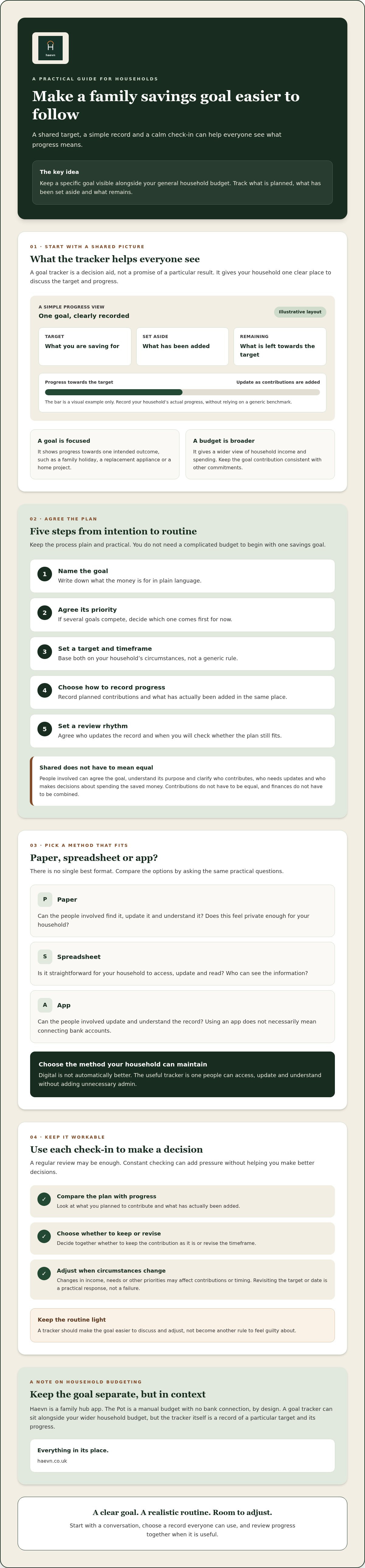
A family savings goal tracker is a record of a shared target and the progress made towards it. It might show what you’re saving for, the target amount, how much has been set aside and what remains. The tracker could be a notebook, spreadsheet or app. The best choice is one your household can update and check without adding unnecessary admin.
A goal is different from a general monthly budget. A budget gives you a broader view of household income and spending, while a goal focuses attention on one intended outcome. A personal budget can help put that goal in context: it helps you plan how money is allocated, while the tracker shows progress towards a particular priority.
Think of the tracker as a decision aid, not a promise of a particular result. It can help you see whether your plan still fits, but changes in household circumstances may affect contributions or timing. The point is to make the goal easier to discuss and adjust, not to create another rule to feel guilty about.
What makes a savings goal a shared family goal?
A goal becomes shared when the people involved understand and agree on its purpose. Before choosing how to record progress, talk about why the goal matters and what success would look like. Then clarify who plans to contribute, who needs updates and who will make decisions about spending the saved money. These roles can vary. A shared goal doesn’t require everyone to combine their finances or contribute equally.
Which goals are worth tracking separately?
Track a goal separately when you want its progress to stay visible alongside other household priorities. You might record savings for a family holiday, a replacement appliance or a home project as distinct goals. A separate record makes it easier to see which target each contribution supports, rather than treating all saved money as one general total. Set the target and timeframe according to your household’s circumstances, not a generic benchmark.
How to set a family savings goal you can track
A useful goal starts with a conversation, not a complicated budget. Agree what you’re saving for, why it matters and what progress you want to see. Then choose a practical way to record it. A family savings goal tracker should make decisions clearer, not create another household admin task.
Try this short sequence:
- Name the goal. Write down what the money is for in plain language.
- Agree its priority. If several goals compete, decide which one comes first for now.
- Set a target and timeframe. Base both on your household’s circumstances, not a generic rule.
- Choose a tracking method. Decide where planned contributions and actual progress will be recorded.
- Set a review rhythm. Agree who updates the record and when you’ll check whether the plan still fits.
Agree the target, priority and timeframe
Ask each person involved what the goal is for and why it matters. People may value different parts of the same outcome, so make expectations clear before settling on a target. If there are several priorities, choosing one to focus on first can make the next step easier to agree.
Set a timeframe that feels workable for your household. There’s no need to borrow a target or deadline from another family. If income, needs or other priorities change, revisit the plan together. Adjusting the date or target is a practical response, not a failure.
This is goal-setting, not a complete budget setup. A household budget looks more broadly at income, regular costs and spending choices. Keep the two connected, so the contribution you agree for a goal makes sense alongside other commitments. You don’t need to build a full budget before setting one savings goal.
Choose a contribution and progress measure
Record what the household plans to contribute and what has actually been added in the same place. That makes it easier to see whether the plan is keeping pace without relying on memory. You can record this manually in a notebook, spreadsheet or app. Your tracking method doesn’t need access to bank accounts.
Agree who will update the record and how often. A regular check-in may be enough. Constant checking can add pressure without helping you make better decisions. At each review, compare the plan with progress, then decide whether to keep the contribution as it is or revise the timeframe.
If a shared digital space would suit your household, you can explore a family hub.
Family savings tracker options: paper, spreadsheet or app?
The right family savings goal tracker is one your household can keep up to date. Compare options by how easy they are to access, update and understand, and by who can see the information. Digital doesn’t automatically mean better, and using an app doesn’t necessarily mean connecting bank accounts.
- Paper: A note on a noticeboard or in a household folder is easy to see at home and quick to update. It may be less convenient if family members need to check progress when they’re out.
- Spreadsheet: A spreadsheet can keep the target, contributions and running total together. Depending on how you share it, household members may need access to the same file or a separate conversation to hear about updates.
- App: An app may make a shared record easier to find and update, particularly if several people need to see it. Check what information it stores, how access is shared and whether updates are manual or connected to other accounts.
When is paper or a spreadsheet enough?
If you’re working towards one goal with few contributors, a notebook or spreadsheet may be all you need. Keep the record simple: write down the goal, agreed target, contributions and current progress. A spreadsheet can be shared digitally, but make sure everyone knows where to find the latest version. If updates happen through conversation instead, agree who will pass them on and when.
Neither format is automatically unreliable or unsafe. Consider who can access the record and where you keep it, then choose what suits your household’s preferences.
What should a family savings app help you see?
Look for a clear view of the goal, progress so far and the next update to make. A useful app should fit the review routine you’ve agreed, rather than prompting constant checking. Ask what information is stored, who can access it and whether you can manage permissions to suit the people involved. Manual entry can be a deliberate choice, giving you control over what you record without bank access.
If savings tracking sits within a wider tangle of household admin, an guide to busy family life may help you decide whether a broader shared tool would suit. Keep wider budgeting questions separate from the savings record itself, so the method stays clear and manageable.
How to keep a family savings goal on track
A savings plan needs room to change. A family savings goal tracker can show whether contributions match the plan, but it shouldn’t become a reason to check the balance every day. Agree a calm review rhythm that gives everyone a chance to look at progress and make adjustments together.
Create a review routine that fits family life
Link the check-in to a household planning moment you already have, such as a regular conversation about upcoming bills or plans. Keep it brief and focused. Look at three things: current progress, the next planned contribution and any change in priorities.
Agree who needs to take part and what information they need. A shared goal doesn’t mean every family member needs equal access to every financial detail. Share enough to make the plan understandable to the people involved, while respecting your household’s preferences around privacy.
What to do when progress changes
An unexpected expense, a change in income or a new household need may affect what you can set aside. That doesn’t make the original goal a failure. It means the plan needs another look.
At a review, talk through the options and agree what feels realistic now. You might:
- Keep the contribution the same and extend the timeframe.
- Reduce the contribution for a while, then review it again.
- Pause the goal if another need has become more important.
Keep essential household commitments in view before deciding what can go towards a goal. If progress has slowed, focus the conversation on the plan rather than on who has contributed more. A practical question such as “Does this still fit our priorities?” is more useful than assigning blame.
Once you’ve agreed a change, update the record so everyone working towards the goal has the same picture. Then set the next check-in and leave the plan alone until that point, unless circumstances change again. This keeps tracking useful without letting it take over your household’s attention.
If a shared space would help you keep household plans in view, take a look at the family hub.
How Haevn helps with this
A savings goal is easier to discuss when it sits alongside the rest of your household spending. Haevn includes The Pot, a manual family budgeting tool.
Use The Pot to keep household money in view
The Pot isn’t a dedicated savings account. It gives your family a place to keep a manual budget in view, which can help put a savings goal in context with other priorities. When reviewing a planned contribution, for example, you can consider it alongside household commitments and decide whether the amount still feels workable.
Because updates are manual, your family chooses what to record and when to review it. The budget view depends on keeping the information current. It can support a conversation about priorities, but it can’t means that a goal will be reached or replace decisions about where to hold savings. For a broader look at planning household spending, use a family budget guide alongside this savings goal approach.
Decide whether a shared family hub suits you
A shared space may suit a household that wants budgeting alongside other family admin. The Circle lets you invite up to eight family members under one subscription. Consider who needs access to the shared view and what details your household wants to record. A tool should fit the way you prefer to manage money, not dictate how you share it.
If you’re comparing options, remember that The Pot is manual and doesn’t connect to bank accounts. That may suit families who want to enter and review budget details themselves. If you prefer automatic account syncing, The Pot doesn’t provide it.
Haevn offers a 30-day free trial with no card required. Start your free trial.
Make your next savings conversation count
A savings plan doesn’t need to be elaborate to be useful. What matters is that the people involved understand the goal and know when you’ll check in again. If the plan needs to change, a straightforward conversation can help you agree the next step without making progress a source of pressure.
Start with one question: what would make this family savings goal tracker feel manageable for our household right now? A clear answer gives you a practical place to begin, and you can revisit it as circumstances change.
Ready to bring household budgeting and family admin together? Start Haevn’s 30-day free trial, with no card required.
Frequently asked questions
How do you set a savings goal as a family?
Agree what you’re saving for, why it matters and who needs to be involved. Choose a target and timeframe that fit your household, then decide who records contributions and shares updates. If priorities compete, agree which goal comes first.
What is the difference between a savings goal tracker and a family budget tracker?
A savings goal tracker records progress towards one target. A family budget tracker gives a wider view of household income and spending. Use the budget to consider what contribution feels workable, then record progress towards the specific goal separately.
Can a family savings goal tracker work without linking a bank account?
Yes. Record contributions and progress manually in a notebook, spreadsheet or app. Bank access isn’t required.
How often should a family review its savings goal?
Choose a regular check-in that fits your household, perhaps alongside an existing planning conversation. Review progress, the next contribution and any changes in priorities. Check sooner if circumstances shift, but constant monitoring isn’t necessary.
What should you do if your family cannot contribute as planned?
Discuss what has changed and agree whether to reduce contributions, extend the timeframe or pause the goal. Update the record, keep essential household commitments in view and focus on adjusting the plan rather than blaming anyone.
Can a budgeting app help a family track a savings goal?
Yes, if it lets your household record the goal and review progress in a manageable way. Check how updates work, what information is stored and who can access it. Apps vary, so don’t assume they connect to bank accounts.