Chore reward system for children: Household harmony guide
Why does asking your child to put away their shoes often feel like a formal negotiation? Most parents start a chore reward system for children with the best intentions, only to find themselves managing a complex sticker chart that requires more effort than the chores themselves. It's exhausting to feel like a project manager in your own sitting room, constantly nagging until the household atmosphere feels heavy with friction. You likely want a home where things get done without a battle of wills, yet most systems fizzle out within a fortnight.
We understand that your time is a finite resource. This guide shows you how to build a sustainable routine that encourages child independence whilst reducing your daily mental load. You will learn how to create a system that requires minimal maintenance and helps children understand the genuine value of contributing to the family. We explore how to move from short-term bribes to a structured environment where everyone plays their part and chores are completed without being asked.
Key Takeaways
- Complex tracking often creates more work for parents than the chores themselves. Simplify oversight so the system doesn't become another administrative burden.
- Understand the psychological difference between a bribe and a reward to foster genuine motivation. This helps children value their contribution to family life.
- A sustainable chore reward system for children requires visibility and flexibility to survive the reality of a busy household. Digital coordination offers shared oversight without the clutter of paper charts.
- Shift from nagging to shared responsibility by setting clear boundaries between everyday expectations and extra tasks. It's often more effective than focusing on the complexity of the reward.
- Focus on child independence to reduce your own mental load. A well-managed routine creates a calmer domestic environment where everyone understands their role.
Why most chore reward systems feel like more work for parents
Setting up a chore reward system for children is usually born from a desire for peace. You want the dishwasher emptied without a debate and the laundry moved without a reminder. However, the reality often looks like a parent hunched over a kitchen table late at night, trying to remember if the toddler actually brushed their teeth on Tuesday. This administrative burden is a form of unpaid labour that often leads to burnout. When you are the only person tracking the progress, you remain the household project manager rather than a parent.
The friction often stems from a lack of centralised visibility. If the system only exists in your head or on a piece of paper that stays in the hallway, you are still the one who has to initiate every action. This leads to the very nagging you tried to escape. Children stop engaging because the feedback loop is inconsistent. If you forget to award a sticker, they forget the task. Managing a paper-based system in a digital world creates a disconnect that most busy parents simply don't have the energy to sustain.
The hidden mental load of household management
Most households have one person who holds the master list of everything that needs doing. When you ask a child or partner to help, you are still the one responsible for the outcome. True harmony comes from sharing the responsibility, not just the tasks. Shared visibility means everyone can see what is outstanding without you saying a word. This reduces the mental load because you no longer have to be the sole source of truth for household chores. Understanding the psychology of rewards helps here; consistency and clear expectations are more effective than sporadic praise or complex bribery.
Why physical charts often fail after two weeks
Paper charts are static in a world that is inherently mobile. The novelty of a shiny sticker is a powerful motivator for roughly ten days, but it quickly becomes part of the furniture. Once the chart is ignored, the system collapses. Physical charts also do not travel well. If you are at the supermarket or a park, you cannot easily update a chart stuck to the fridge. This delay in feedback breaks the connection between the effort and the reward, causing the routine to fizzle out. Relying on physical charts requires you to be physically present at the chart to validate work, which adds another layer of friction to an already busy schedule.
Understanding the psychology of rewards in the family home
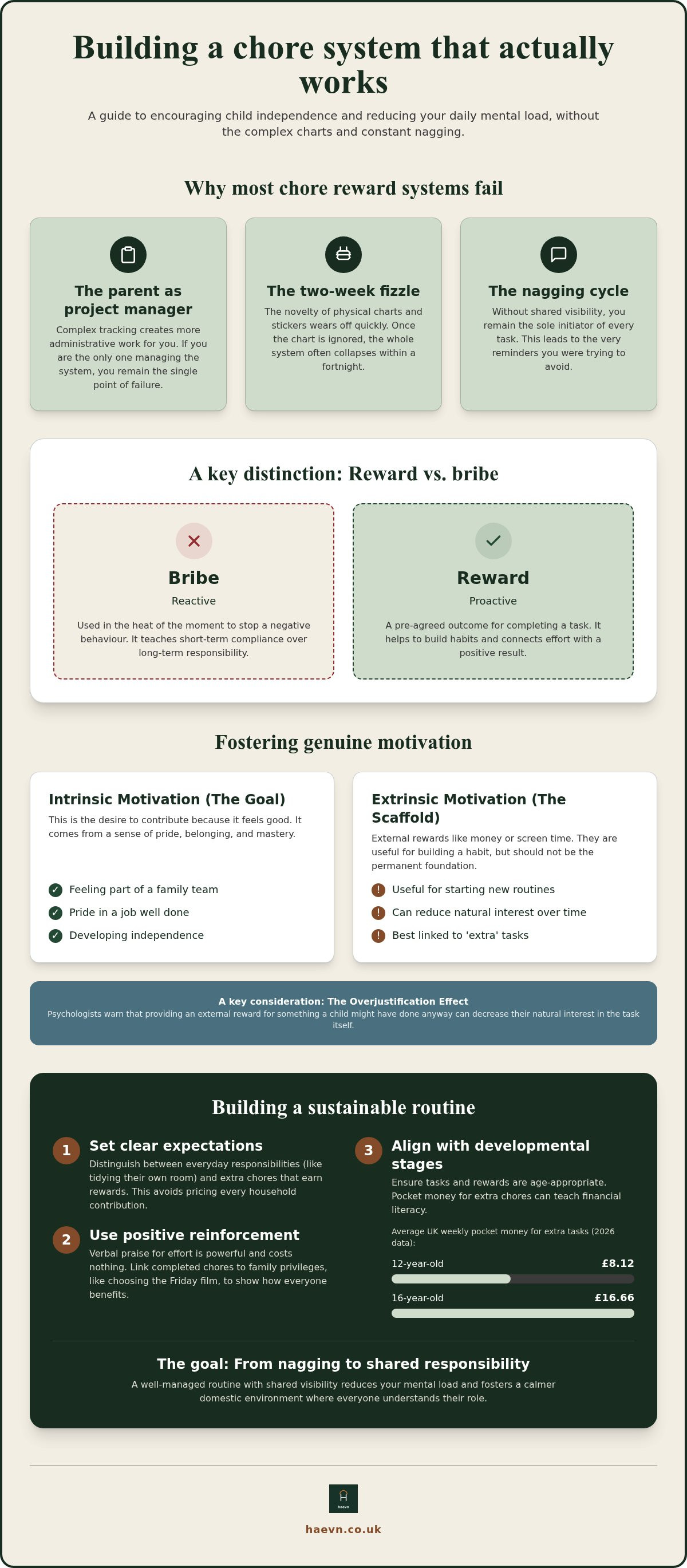
Motivation is often misunderstood as a simple exchange of goods for labour. When building a chore reward system for children, the distinction between a bribe and a reward is vital. A bribe is a reactive tool used to stop a negative behaviour in the heat of the moment. A reward is a proactive agreement made before the task begins. Moving away from reactive parenting requires a shift in how we view these incentives, focusing on the long-term goal of collective effort rather than short-term compliance.
Intrinsic versus extrinsic motivation
The ultimate goal of any domestic routine is to foster intrinsic motivation, where a child feels a sense of pride in their contribution. Extrinsic rewards, like extra screen time or a small payment, act as a temporary scaffold. They help build the initial habit but should not be the permanent foundation. Psychologists warn of the overjustification effect, where providing an external reward for something a child might have done anyway can actually decrease their natural interest. If every task has a price tag, the sense of being part of a family team can start to erode.
The role of positive reinforcement
Verbal praise remains one of the most effective tools for building long-term habits. It costs nothing. It provides immediate feedback. By focusing on a child's effort rather than just the result, you encourage a sense of mastery and independence. Linking chores to family privileges, such as choosing the Friday night film, often works better than physical items. It reinforces the idea that when everyone helps, the whole family benefits from more leisure time. Following expert advice on getting kids to do chores can help you strike the right balance between praise and tangible incentives.
Expectations must also align with developmental stages. A toddler might only manage to put toys in a box for a sticker, whilst a teenager might handle laundry in exchange for later curfew. When refining a chore reward system for children, it helps to look at age-appropriate benchmarks to ensure the system remains fair. To start organising your own household expectations with more clarity, you can create your family space here. This allows for a more composed approach to family admin without the frantic energy of last-minute negotiations.
Comparing physical versus digital reward systems
Paper charts have a tactile charm. They sit on the fridge, visible to anyone in the kitchen. For a modern chore reward system for children, however, they often fall short. They don't update themselves. If you are at work and your child finishes a task, you won't know until you get home. This delay can dampen a child's enthusiasm. Digital tools offer real-time updates and ensure both parents have oversight without needing to cross-reference a physical sheet of paper. You avoid the clutter of half-peeled stickers and ink-stained card that inevitably looks tired after a week.
A centralised hub is essential for household harmony. When everyone can access the same information, the "I didn't know" excuse disappears. It shifts the dynamic from a parent policing a chart to a family participating in a shared plan. This shared visibility is the foundation of a sustainable routine. It allows for a level of transparency that paper simply cannot provide. Everyone knows what is expected, what has been done, and what is left to achieve by the end of the day.
The benefits of a centralised digital list
Automated reminders are a quiet way to keep things moving. They reduce the need for you to be the constant voice of authority. Because these lists are accessible from anywhere, you can check progress whilst on the train or during a lunch break. As children grow, their capabilities change. A digital system allows you to adjust tasks instantly without needing to print a new sheet or find the Tipp-Ex. This flexibility is vital for long-term success. You can move from simple tidying to more complex household contributions as your child's independence develops.
Privacy and the ICO Children's Code
Moving your family life online requires trust. Many apps that appear free fund themselves by selling user data or showing targeted adverts. When choosing a platform, ensure it is built to UK GDPR standards and adheres to the ICO Children's Code. This code means that the best interests of the child are a primary consideration when designing digital services. It means child data is never sold or used for advertising. A secure environment for family coordination is a priority. Privacy is not an optional extra; it is a necessity for domestic life. You should feel confident that your family's private schedule remains just that: private.
Building a sustainable routine without the nagging
Sustainability is the most challenging part of any household change. Most systems fail because they rely on the parent's constant energy to keep them alive. For a chore reward system for children to last, it must move from being a special event to a background rhythm. Consistency matters far more than the size of the reward. If the rules change every Tuesday, children quickly lose interest. It is also helpful to distinguish between basic responsibilities, like putting away a coat, and chores that earn rewards, like washing the car. This clarity helps children understand what it means to be a contributing member of the family.
Five steps to a nagging-free household
Creating a calm environment requires a structured approach that removes you from the role of the enforcer. Use these steps to shift the dynamic:
- Clearly define what is expected of each person to avoid arguments.
- Establish Lists as your single source of truth for the home.
- Schedule specific check-ins rather than making ad-hoc requests throughout the day.
- Let the system do the reminding. When a notification appears on a device, you are no longer the one nagging.
- Involve your children in the setup to ensure they feel a sense of ownership.
Review the routine every month. Habits change and children grow. A task that was a challenge in January might be second nature by March. Adjusting the difficulty means the system remains relevant and stops the family from falling back into old patterns of friction.
Choosing the right rewards for your family
Rewards don't have to be financial or physical objects. In fact, time-based rewards often carry more weight in a busy household. An extra ten minutes of reading before bed or choosing the Saturday afternoon film night creates positive family memories without adding to the clutter. For older children, the reward of 'choice' is a powerful motivator. Letting them choose the dinner menu or which park to visit on Sunday fosters a sense of agency and independence.
If you use pocket money, treat it as a tool for financial education rather than a simple bribe for compliance. To build your own shared routine and reduce the daily friction of household management, you can start your family plan here. This approach centralises the coordination, allowing you to focus on being a parent rather than a project manager.
How Haevn helps with this
Haevn acts as a calm centre for your household management, moving the coordination of your home into a shared, digital space. It is a tool for collective effort rather than a parenting app or a surveillance tracker. When you use Chores to manage your chore reward system for children, you provide your family with a clear view of their contributions without the need for constant verbal reminders. This shared visibility reduces the psychological burden of being the sole person responsible for tracking every task. It helps you move from being a household manager to being a parent again.
Privacy is a fundamental part of the design. The system is built to UK GDPR standards and adheres strictly to the ICO Children’s Code. We do not sell your data or use it for advertising, ensuring your family’s private life remains within your own circle. It is important to remember that this is a coordination tool. It does not offer features for monitoring or surveillance, as we believe in fostering trust and independence within the family home rather than oversight.
Centralising the household with Lists
Lists serves as a single source of truth for your home, replacing scattered notes and fridge-bound charts. You can use it to manage recurring routines or one-off tasks, ensuring that nothing is forgotten in the daily rush. By integrating Chores with Plan, you can see exactly how household tasks fit into the flow of your family's schedule. This holistic approach means that everyone can see what needs doing at a glance, whether they are at home or out for the day. It provides a level of clarity that helps a chore reward system for children remain sustainable for months rather than weeks.
A simple, flat-rate solution for the whole family
We believe family coordination should be straightforward, which is why the pricing is simple. One subscription covers up to eight family members for £6.99 per month or £69.99 per year. There are no per-user fees, complex tiers, or hidden costs to manage. This flat-rate model is designed for the way British families live, offering a professional level of organisation that stays within a predictable budget. It is a composed and practical solution for dual-income households who are time-poor but value a well-ordered home life. You get full access to all features, including Chores and Home, without needing to manage multiple accounts or pay for additional users as your family grows.
Creating a calmer family rhythm
A sustainable chore reward system for children works best when it removes the friction of constant nagging. By shifting from a model of parental surveillance to one of shared visibility, you allow your children to take ownership of their roles whilst developing a sense of contribution. Focus on maintaining a consistent routine rather than increasing the complexity of the rewards. This approach reduces your mental load and helps foster genuine independence in a secure, domestic environment.
Haevn provides a privacy-first design built to UK GDPR standards, ensuring your family coordination remains free from ads, tracking, or hidden fees. It offers a composed way to manage the home without the administrative fuss. Start your free trial. 14 days free, no card needed. Moving towards a more organised household is a steady process, but with the right tools, a harmonious home is within reach.
Frequently asked questions
What is the best age to start a chore reward system?
Children can typically begin participating in a chore reward system for children from around age three. At this developmental stage, they can follow simple, one-step instructions like placing building blocks into a storage bin. The focus should remain on immediate reinforcement, such as stickers or enthusiastic verbal praise. As their motor skills and attention spans increase, you can gradually introduce more complex tasks that reflect their growing role within the household and their increasing independence.
Should I pay my children for doing basic chores?
Many child development experts recommend distinguishing between routine self-care and rewarded tasks. Basic responsibilities, such as making their own bed or clearing their dinner plate, are usually unpaid expectations of being part of a family. Monetary rewards or special privileges are more appropriate for extra jobs that require additional time or effort. This distinction teaches children that some work is done for the collective good, whilst other work earns a specific bonus.
How do I stop my child from only doing chores for the reward?
Focus on the intrinsic value of their contribution by highlighting the results of their hard work. Explain how their help with the laundry has saved you time, allowing the whole family to go to the park earlier. By consistently linking their effort to a calmer home and more shared leisure time, you help them move away from a purely transactional mindset. The goal is to foster a sense of pride in helping the family team.
What are some non-monetary reward ideas for kids?
Non-monetary rewards often carry more weight because they focus on experiences and family connection. You might consider offering:
- An extra story at bedtime or ten minutes of reading time.
- Choosing the menu for a Friday night family dinner.
- Picking the film or activity for a weekend outing.
- A pass from a less favourite task for one day.
These incentives provide meaningful motivation without the need for constant financial exchange or adding more plastic toys to the house.
How do I manage chores fairly between siblings of different ages?
Adjust task difficulty and rewards to match each child's developmental stage to maintain a sense of fairness. A teenager might take responsibility for the weekly vacuuming, whilst a six-year-old focuses on sorting the recycling. Fairness is about the proportionality of effort rather than everyone doing the exact same job. Using a centralised list means that every sibling can see the contributions of others, which helps to minimise arguments about who is doing more work.
Is it safe to use a digital app for my children's chores?
Safety depends on the platform's commitment to data ethics and privacy standards. Ensure any tool you use is built to UK GDPR standards and follows the ICO Children's Code to protect your family's personal information. A secure chore reward system for children should never sell data to third parties or use it for targeted advertising. It functions as a private coordination space that encourages independence rather than a surveillance tool that monitors every move.