Choosing a shared expenses tracker app for your UK household
You might find yourself hesitating before asking your partner if they've paid the latest utility bill, worried that a simple question sounds like a nag. It's a common friction point in many UK homes where dual incomes and rising energy costs make financial clarity feel like a full-time job. Choosing a shared expenses tracker app UK families can rely on is often the first step toward ending this cycle. When you're trying to track irregular costs like school trips or car insurance amongst the daily noise, a spreadsheet often feels more like a burden than a solution.
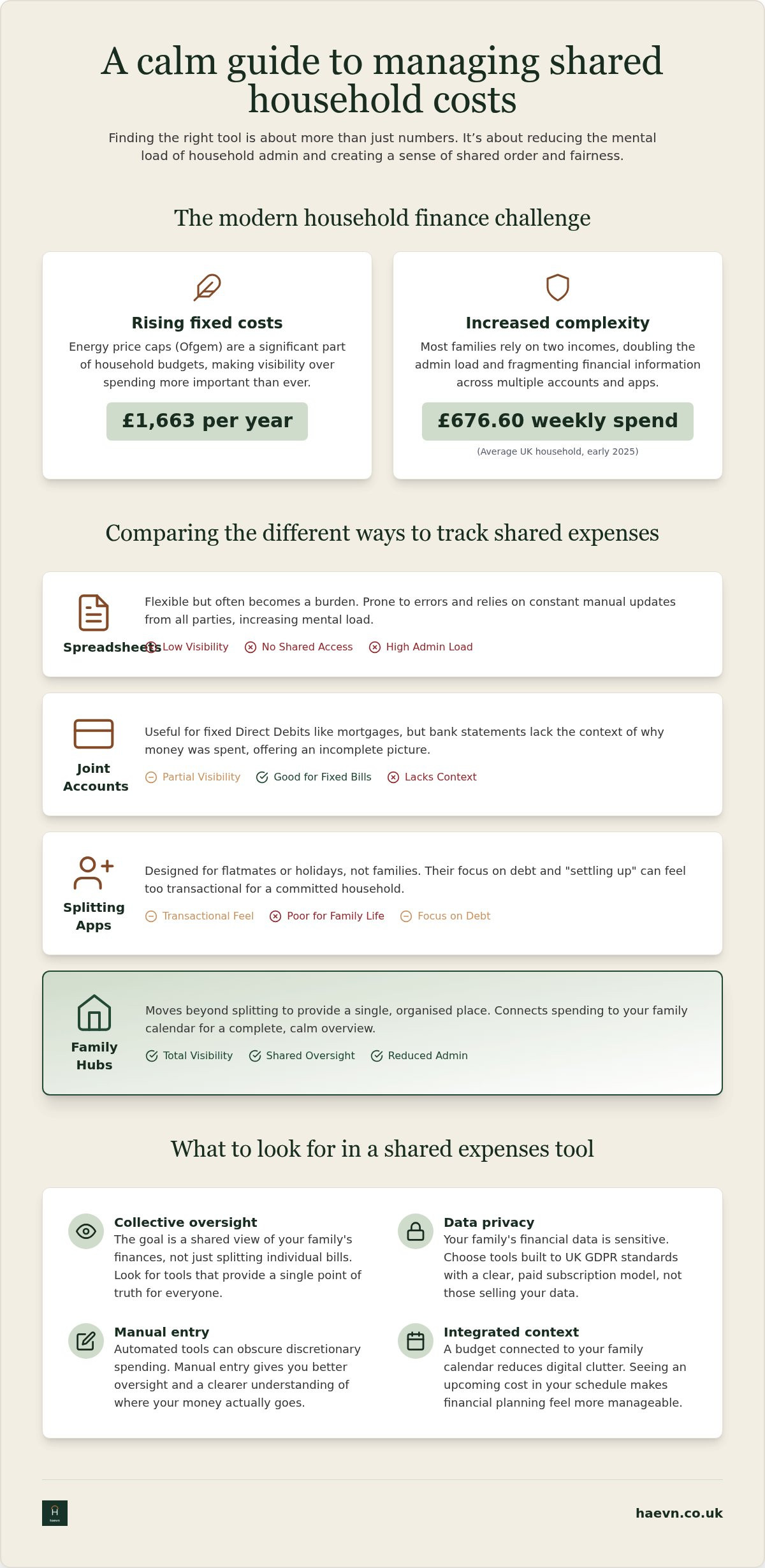
Finding the right tool is about more than just numbers. It's about reducing the mental load of household admin and replacing anxiety with a sense of order. We agree that managing family money should feel like a partnership rather than a series of awkward negotiations. This guide provides a calm path to selecting a tool that offers visibility and fairness whilst protecting your family's data privacy. We'll explore how to move away from fragmented tracking and towards a single, organised place for your household finances.
Key Takeaways
- Understand how modern domestic dynamics increase the mental load of bills and why a central system helps restore household order.
- Compare different methods for managing costs to find a shared expenses tracker app UK households can use together without friction.
- Discover why a tidy interface and manual entry provide better oversight of discretionary spending than automated digital tools.
- Learn the practical steps to move from a complex spreadsheet to a shared digital system that is accessible for every family member.
- Gain a clearer view of your household outgoings to ensure costs are divided fairly and transparently amongst your family.
Why managing shared household costs feels increasingly complex
The British household has changed significantly over the last few decades. Most families now rely on two incomes to manage the rising cost of living. Whilst this provides financial security, it doubles the administrative load. You aren't just tracking one person's spending; you're coordinating two streams of income against a mountain of shared outgoings.
Council Tax, energy bills, and childcare costs form a rigid baseline for most families. With the Ofgem price cap rising to £1,663 per year in July 2026, these fixed costs are taking up a larger portion of the average weekly household spend. Then there are the irregular items that disrupt even the best-laid plans. Car tyres, school uniforms, and home repairs don't appear on a schedule. Traditional methods like paper lists on the fridge or casual verbal agreements often fail here, leading many to search for a shared expenses tracker app UK households can rely on for accuracy. They rely on perfect memory and constant communication, both of which are in short supply during a busy work week.
The rising burden of domestic administration
Managing a modern household budget often means juggling multiple Direct Debits across several bank accounts. If one partner handles the utilities whilst the other manages the mortgage and childcare, neither has a complete picture of the total spend. This fragmentation often leaves one person feeling like the primary organiser, carrying the mental weight of ensuring nothing is missed. It's a heavy psychological burden that can lead to resentment. When financial information is scattered across different banking apps and scribbled notes, household friction becomes a daily occurrence.
Why visibility is more important than splitting
Many people searching for a shared expenses tracker app UK families can use are trying to solve a visibility problem rather than a simple debt problem. In a committed household, a purely transactional mindset feels out of place. You aren't flatmates splitting a pizza; you're a team building a life. The goal is collective oversight.
You need to see where the money is going as a unit to understand your true financial health. This level of shared data leads to better long-term decisions, such as planning for home improvements or adjusting spending to meet rising costs. It moves the conversation away from "who paid for the milk" and towards a shared understanding of your family's future. Having a single point of truth reduces the need for constant questioning and creates a calmer domestic environment.
Comparing the different ways to track shared expenses
Traditional joint accounts were once the default way for couples to coordinate their spending. Whilst they remain useful for fixed Direct Debits like the mortgage or rent, they often fail to capture the full complexity of how couples manage family finances today. A bank statement shows you what was spent, but it doesn't provide the context or the category-level detail needed for a tidy budget. This is where a dedicated shared expenses tracker app UK families can use together becomes a valuable addition to your financial toolkit.
Splitting apps are another popular choice, though many are designed with flatmates or group holidays in mind. These tools focus on debt collection and "settling up," which can feel overly transactional in a committed relationship. You aren't just looking to be reimbursed for a pint of milk; you're looking for a holistic view of your household's financial health. A family hub approach moves beyond simple splitting by integrating your budget with other areas of domestic life.
Standalone splitting apps versus family hubs
Apps built for flatmates often lack the nuance required for a household with children and irregular costs. They are excellent for one-off events but can struggle with the ongoing nature of family life. A family hub connects your spending to your broader schedule. When your budget lives alongside your family calendar, you reduce digital clutter. Seeing an upcoming school trip on the calendar and having the budget entry right there makes the admin feel far more manageable. This single source of truth helps everyone stay updated without the need for constant questioning.
The privacy trade-off in financial software
Many free apps monetise your household spending data by selling it to third parties. If you aren't paying for the software, your private financial habits are often the product being sold. Choosing tools built to UK GDPR standards is a baseline requirement for protecting your family's information. A paid subscription model means that the developer's interests align with yours. It allows for a higher level of data security and a focus on user experience rather than advertising. Investing in a secure platform is a practical way to ensure your private details stay within your household.
If you're looking for a way to bring clarity to your outgoings, you can start organising your shared finances in a dedicated space.
What to look for in a British family budget tool
A tidy interface is essential when you're already managing a cluttered schedule. If a tool is too complex, it becomes another chore that eventually gets ignored. A shared expenses tracker app UK households can actually stick with needs to be intuitive for everyone, from tech-savvy parents to older children. It's about finding a balance between depth of information and ease of use. You need a system that clarifies your financial position rather than adding to the digital noise.
Many tools in this category push for automated bank syncing. Whilst this sounds convenient, it often results in a messy list of transactions that require constant correcting. Manual entry provides a different kind of value. It encourages a moment of reflection on what you're spending and keeps your data private. Choosing a shared expenses tracker app UK families trust means looking for a tool that prioritises your control. You aren't just watching numbers move; you're actively choosing how to categorise costs by household area or by the person who made the purchase.
Features that support household harmony
Clarity is the best way to avoid household friction. Having shared visibility of upcoming bills means no one is surprised when a large payment leaves the account. This foresight allows you to plan ahead rather than reacting to a bank notification. Some platforms also include a private household chat. This is useful for discussing specific costs without cluttering your main messaging apps with admin. You can also store loyalty cards, such as your Tesco Clubcard or Nectar card, in one place. It means that whoever is doing the weekly shop has access to the household savings.
Accessibility for the whole family
A family system only works if everyone can access it. Look for a platform that works in a web browser on any phone, tablet or computer. This means that no one is locked out because of their device choice. The onboarding process should be quick, acknowledging that busy parents don't have an hour to set up a new programme. You can explore these essential family features to see how they fit into your daily routine.
The software should support up to eight members. This flexibility allows you to include older children who are learning to manage their own discretionary spending or regular carers who need to log household expenses. Ultimately, the app should feel like a digital extension of your home rather than a cold piece of financial software. It should be a calm space where your family's financial life is organised and visible.
Moving from spreadsheets to a shared digital system
Many households begin with a spreadsheet. It feels like a logical way to organise a budget. However, these files often become a source of stress because they aren't accessible on the move. They usually require one person to sit at a computer and manually reconcile bank statements. This creates a bottleneck where one partner holds all the information whilst the other is left in the dark. Moving to a shared expenses tracker app UK families can access on their phones changes this dynamic.
To migrate your existing budget, start with your fixed monthly outgoings. Add your mortgage, Council Tax, and utility Direct Debits first. These provide the framework for your spending. Once the big items are in place, you can begin tracking the more fluid categories like groceries and transport. Setting up a routine to review these numbers together once a week helps keep the data accurate. You can use Home to see how your spending aligns with other household tasks. This turns financial management into a shared habit rather than a monthly crisis.
Encouraging participation from everyone is easier when the tool is simple to use. If you have older children, giving them access to see the household budget can be a practical way to teach them about the cost of living. It helps them understand why certain spending choices are made. A collective approach means that the burden of admin doesn't fall on one set of shoulders.
Overcoming the friction of manual tracking
Expense entry works best when it becomes a quick habit rather than a weekly chore. Try logging costs as they happen, such as when you're walking away from the supermarket till. This approach helps you track small daily costs like a coffee or a parking fee that often go unnoticed but impact the total budget. You can distinguish between one-off household bills and recurring costs to see how your discretionary spending fluctuates.
Reducing financial arguments through transparency
Arguments about money often stem from a lack of information. When one person has to ask the other about a specific bill, it can feel like an interrogation. A shared digital system creates a neutral space for financial discussions. Shared data removes the need for constant questioning because the answers are already visible to everyone. This transparency builds a shared responsibility for the family budget. You stop being a passenger in the household finances and become an active participant in the plan. Using a shared expenses tracker app UK households can trust helps turn a point of friction into a point of connection.
If you're ready to leave the spreadsheet behind, you can create your shared household account and start centralising your admin.
How Haevn helps with this
Haevn is built as a central point of origin for your domestic life. It brings together your schedule, your tasks, and your finances into a single, calm environment. At the centre of this is Home, which provides a clear overview of your day, including any financial tasks that require your attention. By integrating your budget with Plan and Lists, the app means that your household outgoings are always viewed in the context of your broader family life.
Bringing order to the household budget
Pot is the dedicated space for your family finances. It functions as a shared expenses tracker app UK households use to log costs manually, ensuring that every entry is deliberate and accurate. Choosing a shared expenses tracker app UK families can trust means prioritising clarity over complex automation. You don't need to link your bank accounts, which maintains a high level of privacy and avoids the clutter of unrecognised automated transactions. This manual approach fosters a sense of shared partnership as you and your partner actively coordinate your spending. Beyond daily costs, you can use House to store home warranties and track recurring service bills, ensuring that every aspect of your domestic administration is organised in one place.
A system designed for your family
We believe that your family's data should remain private. Haevn is built to UK GDPR standards and we never sell your information to advertisers or third parties. To maintain this level of security and provide a calm, ad-free experience, we don't offer a free version of the app. Access for your whole household, up to eight members, is provided through a single flat rate of £6.99 per month or £69.99 per year. There are no tiers or individual plans to manage.
Honesty is important to us, so we're clear about what the app does not do. Haevn does not currently support automatic bank transaction syncing. This is a deliberate choice to prioritise privacy and encourage active oversight of your budget. The app is also not designed for complex investment tracking or business accounting. It is a tool for the domestic sphere, focused on reducing the mental load of managing a busy UK home. By centralising your admin, you can replace digital chaos with a sense of order and shared responsibility.
Creating a calmer financial future for your home
Managing a household budget is about more than just balancing the books. It is about creating a sense of order and fairness that allows your family to thrive. By moving away from fragmented spreadsheets and transactional splitting tools, you can reduce the mental load that often leads to domestic friction. Choosing a shared expenses tracker app UK families can use together provides the visibility needed to make informed decisions without constant questioning.
True financial clarity comes from a system built for the way British families actually live. Whether you are tracking irregular school costs or coordinating the weekly grocery shop, a single point of origin for your admin brings a much-needed sense of calm. Haevn is private and secure by design, offering one flat rate for up to eight family members. You can begin organising your household today with a system that respects your time and your data.
Start your free trial. 14 days free, no card needed.
Taking control of your finances doesn't have to be a source of stress. With the right tool in place, you can build a clearer and more collaborative future for your home.
Frequently Asked Questions
What is the best app for splitting bills with a partner in the UK?
The best tool depends on your goals, but for committed UK couples, a platform that offers visibility over the whole budget is often better than a simple splitting tool. Whilst some apps focus on debt collection between friends, a shared expenses tracker app UK families use should focus on collective oversight. Look for a platform that integrates with your family schedule to provide a holistic view of your domestic outgoings.
Can I track shared household expenses without linking my bank account?
You can track household costs manually to maintain a higher level of privacy and control. Many people find that automated bank syncing creates a cluttered list of transactions that requires constant management. Manual entry means that every expense is categorised correctly from the start. Tools like Pot allow you to log spending without ever connecting your private banking data to the software, keeping your financial habits secure.
How do I organise my family budget on my phone?
Organising your budget on your phone requires a central point of origin for all financial data. Start by logging your fixed monthly costs, such as your mortgage and Council Tax, then add variable daily spending as it happens. Using a shared expenses tracker app UK households can access on the move means that both partners have the same information. This removes the need for a complex spreadsheet that is only accessible from a computer.
Are there any shared expense apps that do not sell my data?
Privacy-first apps that use a subscription model are the most reliable option for protecting your data. Free apps often monetise your information by selling your spending habits to advertisers. Choosing a platform built to UK GDPR standards means your data is handled legally and ethically. A paid service aligns the interests of the developer with your own, prioritising a secure and ad-free experience for your household rather than selling your private details.
What features should a family budgeting app have for UK households?
A family budgeting app should include features that support the complexity of UK domestic life. Look for support for multiple members, the ability to store loyalty cards like your Tesco Clubcard, and a way to categorise costs by household area. It should also work on any phone, tablet or computer. Features like House are useful for tracking home warranties alongside your regular service bills and utility payments in one place.
How can a shared app help reduce the mental load for parents?
Shared apps reduce the mental load by removing the need for one person to be the sole financial organiser. When both parents can see upcoming bills and current spending in real time, the need for constant questioning disappears. This transparency creates a sense of shared responsibility. Centralising the budget alongside the family calendar and task lists means that admin is handled calmly rather than through a series of urgent negotiations.